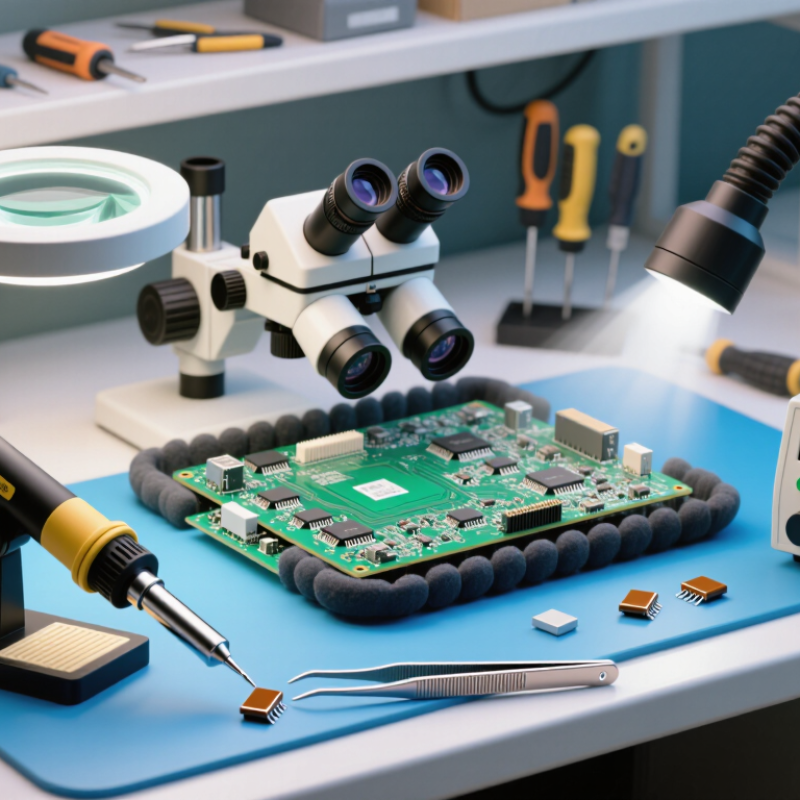
| ESD-safe fine-tip tweezers | Placing chips, resistors, capacitors, and small connectors | Beginner to advanced | Hand placement before soldering or rework | Choose straight or angled tips that align with component size; check that the tips meet evenly. | Use grounded, ESD-safe tools when handling static-sensitive parts. Fine tips can bend if used to pry components. |
| Temperature-controlled soldering station | Prototypes, repairs, and through-hole work alongside SMD assembly | Beginner to advanced | Hand-soldering pads, wires, and larger SMD components | Look for stable temperature control, replaceable tips, suitable tip options, and readily available replacement parts. | A small chisel tip often transfers heat more effectively than an extremely fine tip. Use a temperature appropriate to the solder and component. |
| Hot-air rework tool | Removing or installing multi-lead and leadless SMD packages | Intermediate to advanced | Localized component rework after applying suitable flux | Consider adjustable airflow, temperature control, nozzle options, and a stable holder. | Airflow can shift nearby small parts. Shield adjacent components and avoid heating a board longer than necessary. |
| Magnification lamp or inspection microscope | Inspecting fine-pitch leads, solder joints, and small components | All levels | Placement checks and post-solder inspection | Prioritize comfortable working distance, clear focus, adequate lighting, and a view that suits the board size. | Magnification helps reveal bridges and poor joints, but excessive magnification can make general positioning less comfortable. |
| Stencil and solder-paste applicator | Repeatable paste application on prototype or small-batch boards | Beginner to advanced | Apply paste through stencil apertures before component placement | Match the stencil thickness and aperture design to the PCB footprint and component requirements. | Keep the stencil aligned and clean. Paste consistency, storage, and working time affect print quality. |
| Reflow oven or controlled hot plate | Assembling boards with multiple SMD components | Intermediate | Heat solder paste through a controlled reflow cycle | Check usable board area, temperature control, repeatability, and compatibility with the solder-paste profile. | Follow the solder-paste manufacturer’s recommended thermal profile. Monitor board temperature rather than relying only on a heater setting. |
| Fume extraction system | Reducing exposure to fumes during soldering and rework | All levels | Operate near the work area during soldering and heating | Consider airflow, filter type, filter replacement availability, and whether the intake can be positioned close to the work. | Extraction should capture fumes at the source. It does not replace good ventilation or safe handling practices. |
| Digital multimeter | Checking continuity, resistance, and power rails after assembly | Beginner to advanced | Pre-power checks and fault finding | Choose suitable measurement ranges, clear continuity indication, and probes that can safely contact small test points. | Verify power and polarity before energizing a new board. Avoid probing adjacent fine-pitch pins in a way that could create a short. |