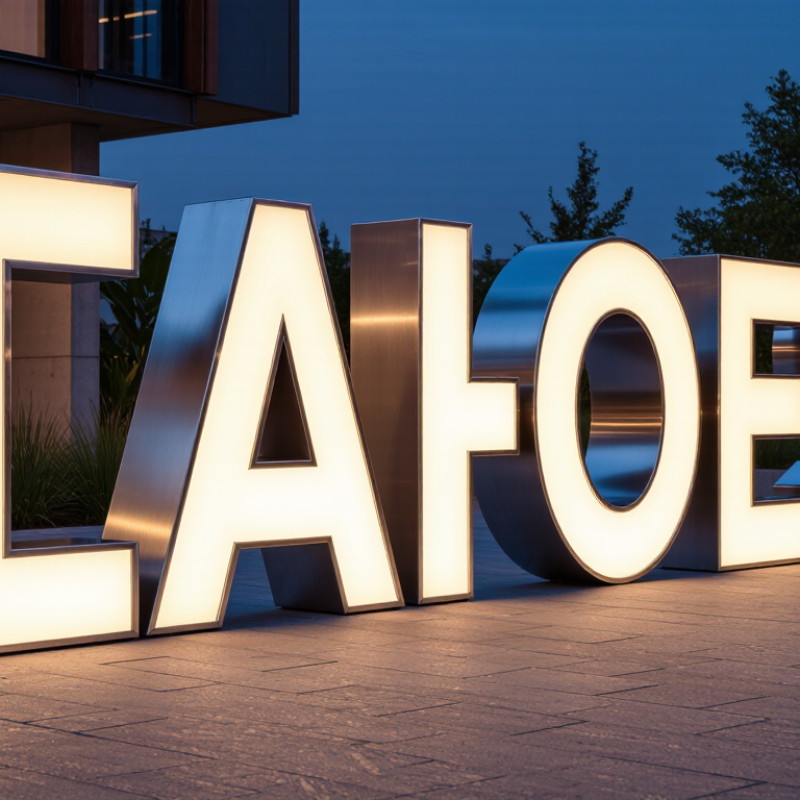
| Front-Lit LED Channel Letters | Opaque or translucent face, formed returns, internal LED modules, and an aluminum or composite back. | Retail façades, shopping centers, offices, hospitality entrances, and street-facing signs. | High daytime readability with strong nighttime visibility; suitable for large viewing distances. | IP65 target
Use sealed faces, gaskets, and protected cable entries for exposed locations. | LED systems commonly use about 8–18 W per square foot of sign face, depending on depth and brightness. Quality LEDs are commonly rated around 50,000 hours under stated test conditions. | Requires a level mounting surface, concealed wiring, an accessible power supply, and a dedicated low-voltage circuit. Structural fixing must suit the wall material and wind exposure. | Approximately US$250–$700 per square foot of letter face, excluding unusual access equipment, electrical upgrades, permits, and structural reinforcement. | Use listed electrical components, correct grounding, strain relief, fire-safe wiring practices, and a disconnect that is accessible to authorized personnel. | Inspect every 6–12 months; clean the face and check fasteners, seals, wiring, and brightness uniformity. |
| Halo-Lit / Reverse-Lit Letters | Opaque metal or acrylic letters with LEDs projecting light onto the wall behind each letter. | Corporate offices, premium retail, hotels, reception areas, and architectural façades. | Elegant halo effect with lower glare; best on clean, light-colored, or suitably reflective backgrounds. | IP65 target
The rear cavity and mounting penetrations require careful sealing against moisture. | Typical system demand is about 5–15 W per square foot, varying with letter depth, spacing, and desired halo width. LED modules are commonly designed for approximately 50,000 hours. | Requires accurate stand-off spacers, a consistent wall surface, concealed low-voltage wiring, and adequate ventilation around power supplies. | Approximately US$300–$850 per square foot, with premium metal finishes and complex mounting increasing the total. | Avoid exposed low-voltage connections, maintain minimum clearances specified by the component supplier, and verify that the wall can support the sign and spacers. | Inspect annually; clean the letters and wall area, check spacer alignment, and examine cable seals for cracking or water ingress. |
| Front-and-Halo-Lit Letters | Letters combine illuminated faces with rear halo lighting, normally using separate LED circuits or zones. | High-impact architectural branding, entertainment venues, landmark entrances, and premium developments. | Very high visual impact from both direct and reflected light; brightness should be commissioned to avoid glare. | IP65 target
Use weather-rated components throughout and provide drainage where water could collect. | Often uses about 12–25 W per square foot, depending on the two lighting layers and control settings. LED life is commonly specified near 50,000 hours, subject to heat management. | Needs more cable routing, larger or multiple power supplies, careful nighttime aiming, and stronger support planning than single-effect letters. | Approximately US$400–$1,000 per square foot, excluding major structural or access costs. | Provide separate circuit identification, overload protection, accessible isolation, secure mounting, and a nighttime glare assessment where pedestrians or drivers may be affected. | Inspect every 6–12 months; test each lighting zone, inspect seals and drivers, and clean both faces and the surrounding wall. |
| Acrylic-Faced Built-Up Letters | Fabricated acrylic faces with metal or plastic returns and internal LED illumination. | Indoor or sheltered outdoor signs where even face illumination and customizable colors are priorities. | Very good face uniformity when letter depth, LED spacing, and diffusion are correctly engineered. | IP54–IP65
Rating depends on enclosure design; fully exposed installations should use sealed outdoor-rated construction. | Typical energy demand is approximately 8–20 W per square foot. Acrylic can discolor, craze, or become brittle if exposed to unsuitable chemicals, impact, or prolonged weathering. | Requires careful handling to prevent face damage, accurate leveling, and access for replacing LED modules or power supplies. | Approximately US$220–$650 per square foot, depending on size, depth, color, and fabrication complexity. | Protect acrylic from impact and incompatible solvents; use UV-suitable materials outdoors and ensure electrical parts are protected from condensation. | Clean every 6–12 months using mild soap and water; avoid abrasive pads, ammonia-based cleaners, and high-pressure spray at seams. |
| Large-Format Flexible LED Neon | Flexible LED strip or molded diffuser mounted in aluminum channels or formed backing to create continuous lines and shapes. | Decorative outlines, curves, symbols, interior feature walls, and façades requiring minimal hot spots. | Continuous visual line with excellent color consistency; usually less intense than deep channel letters at long viewing distances. | IP65–IP67
Outdoor rating applies only when the complete system, connectors, and end caps are suitably protected. | Common power demand is about 5–15 W per meter, although actual consumption varies by product and brightness. Service life is commonly specified around 30,000–50,000 hours. | Needs precise bending radius control, reliable end sealing, suitable mounting channels, voltage-drop planning, and accessible drivers. | Approximately US$100–$400 per linear meter, excluding complex backing structures and installation access. | Do not exceed the stated bending radius or circuit length; protect connectors from water, use correctly sized cable, and provide overload protection. | Inspect every 6–12 months; check adhesive or mechanical clips, connectors, end caps, and sections with reduced brightness. |
| Internally Illuminated Cabinet Letters | Large enclosed letter or logo cabinets with internal LED arrays, diffuser faces, and serviceable rear panels. | Very large signs, elevated façades, transport-related sites, and locations viewed from long distances. | High output and strong long-distance visibility; cabinet depth generally improves light distribution. | IP65 target
Provide drainage, sealed access panels, and corrosion-resistant hardware for exposed sites. | Typical demand is about 10–25 W per square foot. Enclosed spaces require thermal management to preserve LED and driver life. | May require engineered support frames, lifting equipment, anchor calculations, access platforms, and multiple electrical circuits. | Approximately US$450–$1,200 per square foot; structural steel, cranes, permits, and difficult access can substantially increase the project cost. | Obtain a structural review for large or elevated signs, account for wind load, provide safe service access, and use lockable panels where appropriate. | Inspect at least annually; check structure, corrosion, panels, drainage, drivers, and internal temperature conditions. |
| RGB or Tunable-White LED Letters | LED modules or flexible systems with controllers that adjust color, color temperature, brightness, or programmed effects. | Entertainment venues, event spaces, campaigns, architectural features, and locations requiring programmable lighting. | Flexible visual presentation; maximum white output and color accuracy depend on the selected LED system. | IP65 target
Controllers, power supplies, and data connections need protection appropriate to their location. | Typical power demand is about 10–30 W per square foot at maximum output. Continuous full-brightness operation may shorten service life and increase heat. | Requires compatible controllers, data wiring, power-injection planning, surge protection, and commissioning of scenes and brightness limits. | Approximately US$350–$1,000 per square foot, excluding advanced control programming and network infrastructure. | Set brightness limits, prevent rapid flashing where local regulations or accessibility guidance restrict it, secure software access, and isolate power before servicing. | Inspect every 6–12 months; test color consistency, controllers, firmware settings, power supplies, and data connections. |