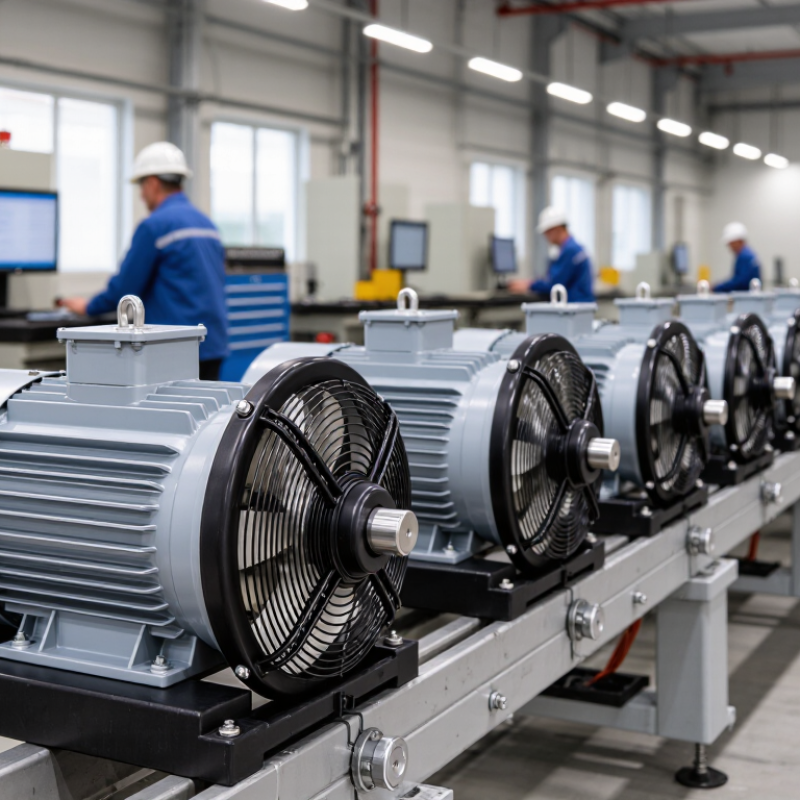
| Motor Design and Application Matching | The motor is selected according to evaporator or condenser fan duty, voltage, frequency, mounting arrangement, ambient temperature, and required airflow. | Rated voltage, frequency, output power, rotational speed, torque, insulation class, enclosure protection, and operating temperature. | Design review, electrical calculations, prototype evaluation, and application-specific performance testing. | The selected motor should meet the equipment duty point without exceeding its thermal, electrical, or mechanical limits. |
| Laminations and Magnetic Core | Electrical-steel laminations are stamped, deburred, stacked, and secured to form the stator and rotor cores. | Lamination thickness, burr height, stack height, slot geometry, concentricity, and core-locking condition. | Dimensional inspection, visual examination, and sampling checks with gauges or coordinate measuring equipment. | Core dimensions and slot geometry must remain within the approved engineering drawing tolerances. |
| Copper Winding | Automatic or semi-automatic winding equipment forms the coils, while operators or machines connect, shape, and secure the winding ends. | Wire diameter, turns per coil, winding resistance, connection sequence, slot fill, and terminal arrangement. | Resistance measurement, visual inspection, turn-count control, and electrical analyzer testing. | Resistance and winding configuration must be consistent with the approved design and phase-balance requirements. |
| Insulation System | Insulating materials are fitted between conductive parts and the core; windings are treated with varnish or another approved insulation process when required. | Insulation material, dielectric strength, insulation resistance, curing temperature, and curing time. | High-potential test, insulation-resistance test, and process-temperature recording. | No dielectric breakdown is permitted during the specified high-potential test; insulation resistance must satisfy the product specification. |
| Rotor, Shaft, and Bearing Assembly | The rotor is mounted on the shaft, bearings are installed, and the rotating assembly is checked for alignment and smooth movement. | Shaft diameter, bearing fit, axial play, radial runout, rotor balance, and lubricant compatibility. | Runout measurement, manual rotation check, bearing inspection, and dynamic balancing. | The shaft and rotor must rotate smoothly without abnormal contact, excessive play, or vibration. |
| Housing and Fan Interface | End shields, housings, mounting brackets, terminals, and fan interfaces are assembled using controlled fixtures and fastening procedures. | Mounting-hole position, shaft extension, housing dimensions, fastener torque, connector position, and sealing condition. | Gauge inspection, torque verification, visual inspection, and sample fit checks with the fan assembly. | Critical interfaces must fit correctly and must not create shaft misalignment or interference with the fan blade. |
| Electrical Safety Testing | Finished motors are connected to automated end-of-line electrical test equipment before packing. | Winding resistance, insulation resistance, dielectric withstand, current, power input, and phase or auxiliary-winding condition. | Automatic motor analyzer and calibrated electrical safety tester. | Each unit must pass the approved electrical limits; failed units should be isolated and investigated. |
| No-Load Running Test | The motor is operated at its specified supply condition to confirm starting, direction, speed, current, and general running behavior. | Supply voltage, frequency, no-load current, rotational speed, start-up behavior, and operating noise. | Test bench with tachometer, current meter, voltage meter, and noise or vibration monitoring. | The motor should start reliably, rotate in the specified direction, and remain within approved current, speed, noise, and vibration limits. |
| Temperature-Rise Evaluation | Sample motors are operated under defined load and ambient conditions until temperatures stabilize or the test duration is completed. | Winding temperature, bearing temperature, ambient temperature, load point, and test duration. | Thermocouples, resistance-change calculations, or other calibrated temperature measurement methods. | Measured temperatures must remain below the limits established for the insulation system, bearings, and application. |
| Airflow and Fan Performance | When supplied as a fan-motor assembly, the motor is evaluated with the specified blade and guard or housing arrangement. | Airflow, static pressure, speed, input power, efficiency, and operating sound. | Airflow test chamber, anemometer or calibrated flow instrumentation, pressure measurement, and electrical power analyzer. | Performance results must meet the approved fan curve or application-specific specification at the defined test conditions. |
| Vibration and Noise Control | Balancing, bearing control, shaft alignment, and fastening procedures are used to reduce mechanical and electromagnetic noise. | Vibration velocity or acceleration, sound pressure level, rotational speed, and test-room conditions. | Vibration analyzer and sound-level meter operated under a documented procedure. | Results must remain within the agreed product limits without rattling, scraping, or abnormal tonal noise. |
| Environmental and Reliability Testing | Qualification samples may be exposed to defined temperature, humidity, endurance, cycling, or storage conditions based on the application. | Test temperature, relative humidity, operating cycles, duration, start-stop frequency, and post-test condition. | Temperature-humidity chamber, endurance bench, and post-test electrical and mechanical inspection. | The motor should retain required safety, electrical, mechanical, and performance characteristics after the defined test sequence. |
| Traceability and Final Quality Control | Production lots are identified through work orders, inspection records, material batches, and end-of-line test results. | Lot number, date code, operator or workstation record, test result, nonconformance status, and packaging condition. | Document review, barcode or serial tracking where applicable, final visual inspection, and sampling audit. | Only products with completed records and accepted inspection results should be released for shipment. |