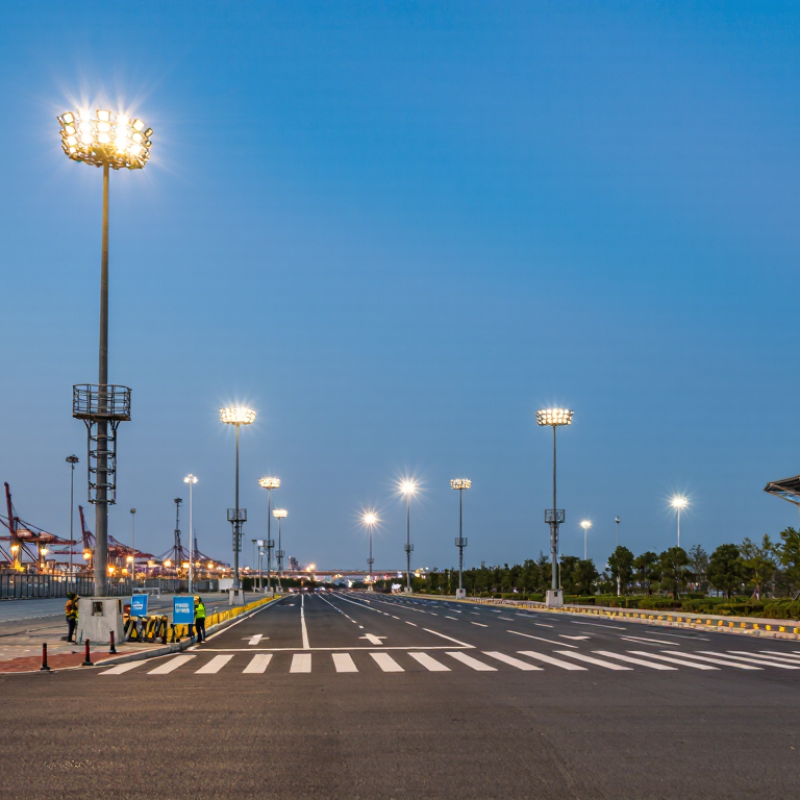
| 1 | Definition and Mounting Height | High mast lighting generally uses poles about 15–40 m high with one or more luminaires mounted near the top. | A greater mounting height can cover a wider area and reduce the number of poles required. | Expressways, ports, airports, logistics yards, and large public spaces. |
| 2 | LED System Efficacy | Modern outdoor LED systems commonly provide approximately 120–180 lm/W at the system level, depending on design and operating conditions. | Higher efficacy can lower electricity consumption while maintaining the required illuminance. | Energy-conscious municipal and industrial lighting projects. |
| 3 | Rated Power Range | Typical LED high mast installations use approximately 240–1,200 W per pole, subject to pole height, layout, and lighting requirements. | Power selection affects coverage, energy cost, glare, and compliance with the lighting design. | Road interchanges, container terminals, stadium surroundings, and open yards. |
| 4 | Ingress Protection | IP65 or IP66 is commonly specified for outdoor LED luminaires; the exact rating should be verified in the product documentation. | Protection against dust and water helps support reliable operation in exposed environments. | Coastal areas, rainy regions, dusty industrial sites, and open-air facilities. |
| 5 | Mechanical Impact Resistance | IK08 or higher is often selected for outdoor luminaires where resistance to mechanical impact is required. | A stronger housing can reduce the risk of damage during service, weather events, or nearby operations. | Transport hubs, construction zones, warehouses, and industrial compounds. |
| 6 | Color Temperature | Common choices range from 3,000 K to 5,700 K; warmer light may be preferred near residential areas. | Color temperature influences visual comfort, atmosphere, visibility, and potential light impact on nearby communities. | Urban roads, industrial estates, ports, parking areas, and recreational spaces. |
| 7 | Optical Distribution | Narrow, medium, wide, and asymmetric beam distributions are used according to the area geometry and pole arrangement. | Correct optics improve uniformity and help limit wasted light, glare, and excessive spill light. | Linear highways, circular plazas, rectangular yards, and irregular open areas. |
| 8 | Control and Dimming | Common control options include photocells, time schedules, 0–10 V dimming, DALI, and wireless monitoring systems. | Controls can adjust output to traffic patterns and support fault monitoring and energy management. | Smart-city roads, campuses, ports, industrial parks, and managed parking facilities. |
| 9 | Structural and Wind Design | Pole thickness, foundation, luminaire area, and wind speed must be calculated for the specific project location; there is no universal pole specification. | Proper structural design is essential for safety, stability, and long-term service performance. | Coastal zones, typhoon-prone areas, elevated sites, and exposed highways. |
| 10 | Maintenance and Serviceability | Typical features include lowering mechanisms, modular LED compartments, surge protection, replaceable drivers, and accessible inspection points. | Convenient maintenance can reduce service time, equipment downtime, and lifecycle operating costs. | Large sites where mobile elevating equipment or frequent manual access is costly. |