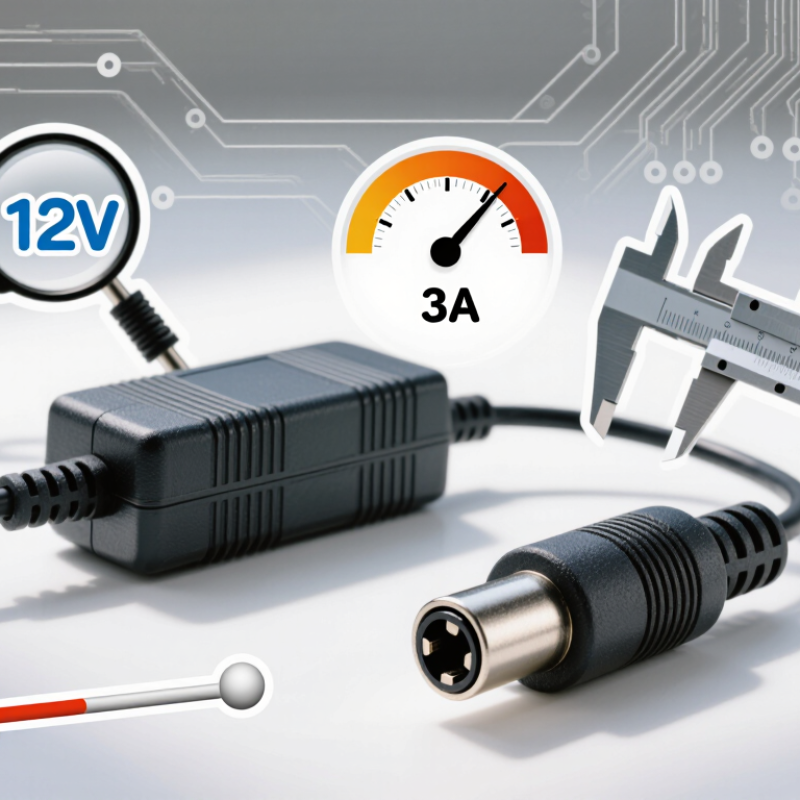
| 1 | Match the DC Output Voltage | The device must be designed for a nominal 12 V DC input. Voltage is not interchangeable with current. | Select an adapter labeled Output: 12 V DC. Do not use a higher-voltage adapter unless the equipment manufacturer specifically permits it. | Excessive voltage can overheat or permanently damage electronic components, while insufficient voltage may cause unstable operation. |
| 2 | Confirm the Current Rating | A 3 A adapter can provide up to approximately 36 W at 12 V, calculated as 12 V × 3 A = 36 W. | The adapter current rating should be at least 3 A when the device requires 12 V and 3 A. A higher current rating is generally acceptable if the voltage, connector, and polarity also match. | The load draws the current it needs. An adapter rated below the required current may overheat, shut down, or produce voltage drop. |
| 3 | Check the AC Input Range | Common input ratings include 100–240 V AC, 50/60 Hz. The input rating must cover the local mains voltage and frequency. | For worldwide use, choose an adapter marked 100–240 V AC, 50/60 Hz. For a single region, verify compatibility with its nominal mains supply before use. | A compatible input range allows the power supply to operate safely without excessive heating or incorrect regulation. |
| 4 | Verify Polarity and Connector Size | The plug must have the correct barrel dimensions, including outer diameter, inner diameter, and length. Polarity is commonly shown by a symbol. | Match the device label or manual exactly. For a center-positive device, the polarity symbol must show positive center / negative sleeve. Do not rely on appearance alone. | A wrong connector can make poor electrical contact, and reversed polarity can prevent operation or damage the device. |
| 5 | Review Safety and Performance Details | Look for appropriate electrical safety markings, short-circuit protection, over-current protection, over-voltage protection, and adequate insulation. | Prefer a regulated switching adapter with documented protection features, suitable operating temperature limits, and efficiency information. Confirm that the plug and cable are suitable for the intended current. | Protection features reduce risk during faults, while proper regulation helps keep the DC output within the range expected by the connected equipment. |