How to Choose a Small Travel Motor?
Choosing a Small Travel Motor requires more than matching a nameplate size. The motor must suit the machine’s weight, track width, travel speed, and working environment. A compact excavator on wet clay faces different demands from a tracked carrier on level concrete. Field experience shows that operators often focus on peak torque and overlook heat, oil cleanliness, and continuous duty. That mistake can shorten service life.
A reliable selection begins with verified specifications. Check displacement, rated pressure, maximum pressure, output torque, speed range, and mounting dimensions. Confirm the motor’s compatibility with the hydraulic pump, planetary gearbox, brake, and track assembly. Manufacturer datasheets provide essential limits, but an experienced distributor can explain how those figures behave under real loads. Ask about seal materials, replacement parts, warranty terms, and service support. Small details matter.
Think beyond the first purchase.
Installation space deserves careful measurement. A few millimeters can affect hose routing or brake access. Consider steep slopes, frequent reversing, shock loads, and long travel distances. These conditions may require a stronger motor than basic calculations suggest. However, oversizing is not automatically safer. It can reduce efficiency, increase cost, and strain other components. My own judgment can still be incomplete without the machine’s pressure readings and duty cycle. Recheck the data before ordering. The best Small Travel Motor balances performance, durability, efficiency, and practical maintenance.
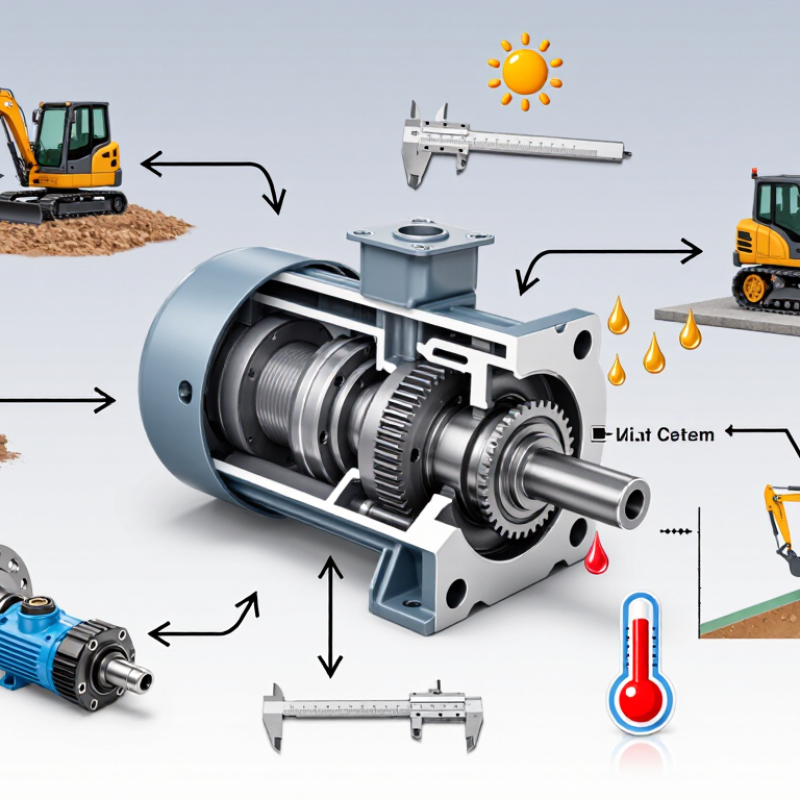
Define the Operating Conditions and Travel Motor Requirements
Before choosing a small travel motor, define the machine’s real operating conditions. Record total mass, maximum slope, wheel or sprocket radius, travel speed, duty cycle, and ground resistance. A 2,000 kg machine on compact gravel needs very different torque from the same machine on wet clay. Measure actual conditions when possible. Catalog assumptions are often optimistic.
Use pressure and displacement calculations to check the requirement. Required torque can be estimated with T = Δp × D × ηm ÷ 2π, while flow depends on displacement, speed, and volumetric efficiency. Include starting torque, not only running torque. A motor that moves smoothly may still stall against a curb. The 2023 Off-Highway Research market report recorded roughly one million construction equipment units sold globally, showing how widely compact travel systems are used. However, market volume cannot replace site measurements. This is where many selections go wrong.
Check continuous pressure, peak pressure, thermal load, and contamination control. ISO 4406:2021 defines hydraulic-fluid cleanliness using a three-number particle code, so filtration should match the motor and valve requirements. Compare the calculated flow with the pump’s measured output, especially at low engine speed. Leave practical reserve, but avoid excessive oversizing; it can reduce control accuracy and increase heat. I would also test the motor on the steepest route, because laboratory results rarely capture loose soil, cold oil, or uneven loading.
How to Choose a Small Travel Motor? — Define the Operating Conditions and Travel Motor Requirements
The chart estimates the continuous tractive force required for a 2,000 kg tracked machine under different operating conditions. The calculation uses F = m × g × (rolling resistance + grade), with a 20% engineering allowance for load variation and drivetrain losses.
Select a travel motor whose continuous tractive force exceeds the highest expected operating requirement. Check starting torque, travel speed, sprocket radius, duty cycle, hydraulic flow, and allowable motor pressure before final sizing.