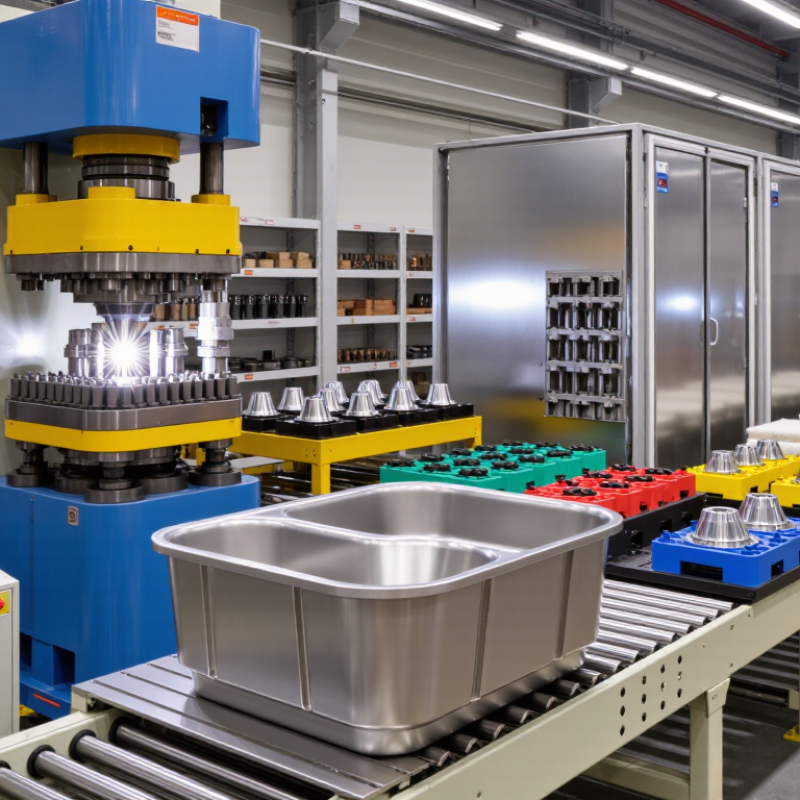
| Definition | Specialized molds, dies, fixtures, gauges, and production aids used to form and assemble dishwasher components. | Tooling controls the shape, position, dimensions, and repeatability of parts throughout production. | It converts design specifications into consistent, manufacturable parts. |
| Sheet-Metal Dies | Press tools used for cutting, bending, punching, and drawing metal sheet. | A press applies force to the die and forms stainless-steel or coated-steel panels into tubs, doors, brackets, and structural parts. | Accurate dies reduce deformation, rework, sharp edges, and dimensional variation. |
| Deep-Drawing Tooling | Tooling that stretches sheet metal into a deeper three-dimensional shape. | A punch pushes the sheet into a die cavity while a blank holder helps control wrinkling and tearing. | It enables the production of watertight dishwasher tubs with smooth internal surfaces. |
| Injection Molds | Molds used to shape molten plastic into functional or decorative components. | Plastic is injected into a heated mold, cooled until rigid, and then ejected using pins or automated mechanisms. | They support high-volume production of spray-arm parts, racks, covers, brackets, and control housings. |
| Assembly Fixtures | Devices that hold components in a defined position during joining or installation. | Locators, clamps, and supports maintain alignment during welding, fastening, riveting, or adhesive application. | They improve assembly speed, operator safety, and part-to-part consistency. |
| Welding Fixtures | Fixtures designed to position metal components during spot, seam, or other resistance-welding operations. | The fixture controls joint location and access while electrodes or welding equipment create the bond. | Stable positioning helps maintain structural strength and reduces distortion or missed welds. |
| Checking Gauges | Inspection tools used to verify critical dimensions, clearances, and assembly locations. | Go/no-go gauges, profile gauges, height gauges, and coordinate-measuring equipment compare parts with defined tolerances. | They detect defects before parts move to later operations or final assembly. |
| Typical Tool Materials | Tool steels, hardened steels, aluminum, engineering plastics, and wear-resistant inserts. | Material selection depends on forming load, production volume, temperature, abrasion, corrosion exposure, and required surface finish. | Appropriate materials extend tool life and help maintain dimensional accuracy. |
| Design Inputs | Three-dimensional product data, material specifications, tolerances, production volume, and process requirements. | Engineers use these inputs to determine parting lines, draft angles, forming stages, locating points, and access for maintenance. | Clear design inputs prevent interference, premature wear, and costly tooling changes. |
| Manufacturing Process | The sequence used to produce tooling, including machining, heat treatment, polishing, coating, and trial runs. | Computer-controlled machining creates the tool, followed by finishing and testing with representative parts. | A controlled process improves tool accuracy, surface quality, and production readiness. |
| Quality Checks | Dimensional inspection, functional trials, leak checks, surface inspection, and process capability reviews. | Tooling is tested under production-like conditions before full-scale manufacturing begins. | Early validation reduces scrap and confirms that components meet fit, function, and safety requirements. |
| Maintenance Needs | Cleaning, lubrication, sharpening, replacement of wear parts, calibration, and repair of damaged surfaces. | Maintenance teams inspect contact surfaces, alignment features, cutting edges, ejectors, sensors, and clamps at planned intervals. | Regular care preserves accuracy, reduces unplanned downtime, and extends service life. |
| Business Impact | The effect of tooling on production cost, cycle time, quality, flexibility, and launch timing. | Well-designed tooling supports repeatable automated or manual operations with fewer adjustments and interruptions. | Effective tooling improves productivity while helping control defects, labor requirements, and total manufacturing cost. |