| Exhaust manifolds or headers | Attached to the engine’s exhaust ports | Collect hot exhaust gas from the engine cylinders. | On many V-type engines, each cylinder bank feeds its own exhaust path. Some engines use a different layout, so the number of pipes does not always match the number of banks. |
| Oxygen sensors | Before and, on many vehicles, after the catalytic converters | Measure oxygen in the exhaust to support fuel control and emissions-system monitoring. | The engine computer uses sensor signals to adjust the air-fuel mixture and check catalyst performance. Sensor placement and quantity vary by vehicle. |
| Catalytic converters | In the exhaust paths, generally upstream of the mufflers | Reduce regulated pollutants in the exhaust. | Catalyst materials promote chemical reactions that convert pollutants into less harmful gases. The number and arrangement depend on the vehicle and its emissions requirements. |
| Crossover pipe (optional) | Connects the left and right exhaust paths, commonly beneath the vehicle | Allows exhaust pulses to communicate between the two sides. | An H-pipe or X-pipe can balance pressure and alter exhaust sound. A system with a crossover still has two main paths, but they are not completely separate. |
| Exhaust pipes | Run beneath the vehicle from the engine toward the rear | Carry exhaust gas through the system and route it away from the passenger compartment. | A dual setup typically uses two main routes for some or most of the system. Pipe diameter, bends, and routing affect fit, noise, and flow. |
| Resonators (optional) | Usually installed in the midsection of one or both exhaust paths | Tune or reduce particular sound frequencies. | Resonators use internal chambers or passages to influence sound. They are separate from mufflers and are not present in every system. |
| Mufflers | Toward the rear of the vehicle, often one per exhaust path | Reduce exhaust noise. | Internal chambers, perforated tubes, or sound-absorbing materials reduce noise as gas passes through. Design and placement influence the system’s sound. |
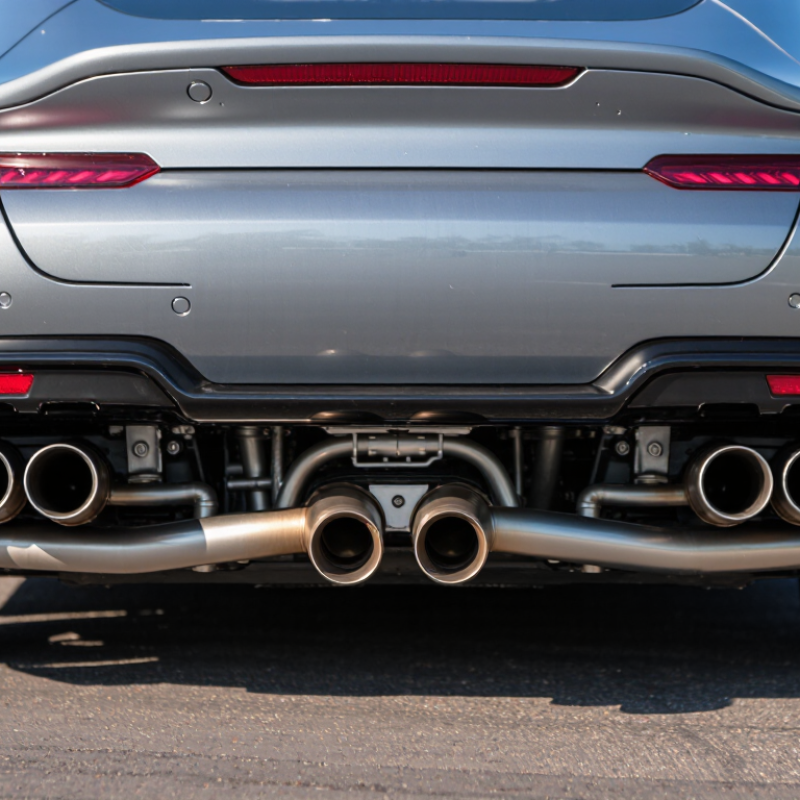
| Tailpipes and outlets | At the rear or, on some vehicles, along the sides | Discharge exhaust gas away from the vehicle. | A dual exhaust often ends in two outlets, but outlet count alone does not prove the system has two independent exhaust paths; some systems split a single pipe near the rear. |