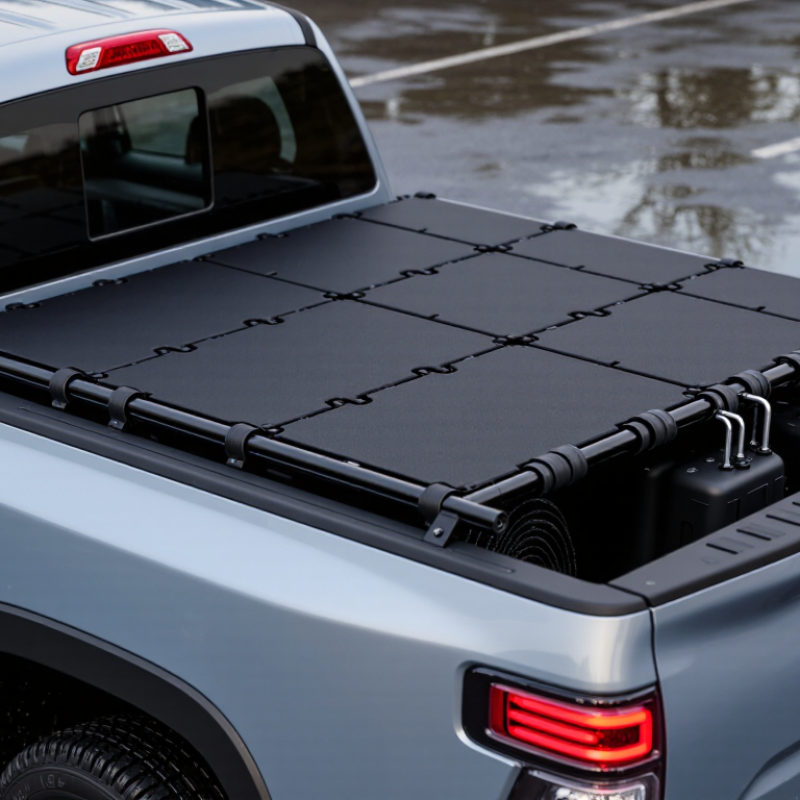
| Basic Function | Motorized opening and closing | An electric motor drives the cover along side rails or rotates a connected shaft. The user normally operates it with a switch, remote control, or vehicle-integrated control. | The electrical system should be protected from direct water entry, road spray, condensation, and debris during normal use. |
| Cover Construction | Interlocking slats, hinged panels, or flexible powered material | Hard slats generally provide a more controlled sealing surface, while flexible materials depend more heavily on side seals, front seals, and tailgate sealing geometry. | The cover design, rail alignment, drain paths, and seal compression affect real-world water management more than the cover material alone. |
| IP Code Purpose | IEC 60529 enclosure classification | An IP code describes the protection provided by a specific enclosure against solid objects and water. It does not automatically certify the complete truck-bed cover installation. | Always verify which component was tested, because a motor housing may have an IP rating while the complete cover, rails, wiring, and connectors may not share the same rating. |
| IP6X: Dust Protection | Dust-tight | The highest first-digit IP level indicates that dust is not expected to enter the tested enclosure in harmful quantities under the specified test conditions. | This is useful for motors and control housings exposed to road dust, sand, and fine particles, but it does not describe water protection. |
| IPX4: Splash Protection | Water splashing from any direction | The tested enclosure is protected against splashing water from all directions under the applicable test conditions. | Suitable for many ordinary splash exposures, but not equivalent to protection from high-pressure washing, heavy spray, or immersion. |
| IPX5: Water-Jet Protection | Protection from water jets | The enclosure is tested against water projected by a nozzle from different directions. | This can be relevant to motor housings and connectors exposed to road spray, although installation orientation and cable-entry sealing remain important. |
| IPX6: Powerful Water-Jet Protection | Protection from powerful water jets | The enclosure receives a more demanding water-jet test than IPX5. | It may provide additional resistance during severe spray or cleaning, but it still does not indicate immersion protection. |
| IPX7: Temporary Immersion | Temporary immersion up to 1 m under specified conditions | The tested enclosure is designed to withstand temporary immersion according to the applicable test procedure. | IPX7 alone does not automatically guarantee protection against powerful water jets. A product tested for both conditions may use a dual designation such as IPX6/IPX7. |
| IPX8: Continuous Immersion | Immersion beyond IPX7 conditions, as specified by the manufacturer | The test depth and duration are not universally identical; they must be stated by the responsible manufacturer or test documentation. | This rating applies only to the tested enclosure and defined conditions. It should not be interpreted as proof that an entire truck bed remains dry. |
| Front Header Seal | Continuous compression seal | A seal at the front of the bed closes the gap between the cover assembly and the bulkhead or cab-side area. | The seal must remain correctly positioned and compressed. Dirt, distortion, poor fit, or insufficient compression can create a leak path. |
| Side-Rail Seals | Gasket or brush-style sealing surfaces | Side seals help guide water toward designated channels while limiting entry between the cover and the rails. | Brush seals can allow controlled drainage and movement, whereas solid gaskets may require accurate alignment and consistent compression. |
| Tailgate Interface | Overlapping or compression seal | The rear seal manages the joint between the cover and the tailgate, one of the most variable areas on a pickup bed. | Water resistance depends on tailgate design, adjustment, load movement, seal condition, and whether the tailgate is closed before the cover. |
| Drainage System | Integrated channels and drain tubes | Many powered covers collect water in the rails and route it through tubes toward the ground or existing body drainage points. | Blocked, kinked, disconnected, or incorrectly routed drains can cause water to accumulate even when the seals are intact. |
| Cable and Connector Sealing | Sealed connectors and protected cable entries | Electrical connections should use suitable grommets, connector seals, or protected junctions to reduce water and corrosion exposure. | The weakest connector, splice, or cable entry can determine practical weather resistance for the electrical system. |
| Water Resistance vs. Waterproofing | Design-dependent, not absolute | A weather-resistant cover is intended to reduce water entry during normal rain and road exposure; it is not necessarily watertight in every condition. | Truck-bed covers commonly manage water through overlapping surfaces, seals, and drainage rather than creating a permanently sealed enclosure. |
| Pressure-Washing Limits | Follow the installation and care instructions | High-pressure water can force water past seals, cable entries, moving joints, and drainage interfaces even when a component has a high IP rating. | Avoid directing a pressure-washer nozzle at close range toward seals, motor housings, connectors, and rail openings unless the product documentation specifically permits it. |
| Maintenance Factors | Periodic inspection and cleaning | Cleaning the rails, checking drain tubes, inspecting seals, and confirming fastener alignment helps preserve operating performance. | Replace cracked, hardened, flattened, or displaced seals. Remove leaves, mud, and grit that could obstruct drainage or prevent full closure. |
| Practical Selection Rule | Evaluate the complete system | Compare the cover design, motor enclosure, connectors, seals, drainage arrangement, installation method, and documented test conditions. | An IP rating is valuable evidence, but complete weather performance also depends on correct installation, vehicle fit, maintenance, and the condition of every sealing interface. |