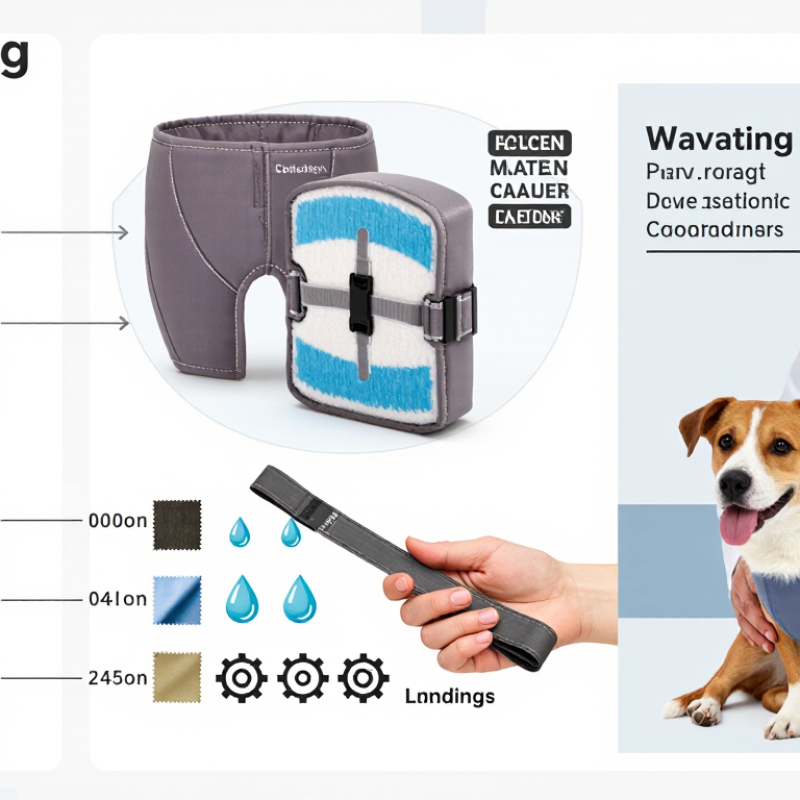
| Sample Comparison | Low-profile chassis height | The absorbent assembly should remain slim enough to avoid restricting walking, sitting, and tail movement. | Dimensional drawing, compressed-thickness measurement, and photographs on dogs of different body shapes. | Excess bulk can cause chafing, slipping, heat retention, and poor user acceptance. | Critical | 15% |
| Fit and adjustability | Multiple waist sizes, secure hook-and-loop or snap adjustment, elastic leg and waist zones, and a defined tail opening. | Size chart, tolerance range, adjustment photos, and fit-testing notes for male and female dogs. | Dogs vary substantially in waist shape, body length, coat density, and tail position. | Critical | 13% |
| Leakage and absorbency performance | Absorbency should be validated with a documented test method, liquid volume, holding time, and leakage inspection. | Laboratory or internal test report showing absorbent capacity, rewet, leakage, and seam performance. | Marketing claims are not comparable unless test conditions are consistent. | Critical | 15% |
| Material comfort and construction | Soft skin-contact layer, breathable backsheet, smooth seams, rounded edges, and no exposed sharp components. | Material specification sheet, fabric composition, seam photographs, and a physical sample inspection checklist. | Contact irritation often results from rough seams, trapped moisture, or abrasive fasteners. | Critical | 12% |
| Washability and durability | For reusable designs, the supplier should define washing temperature, detergent limits, drying method, and expected wash cycles. | Care label, wash-cycle report, dimensional-change results, and post-wash photos. | Performance can change after washing because of shrinkage, delamination, elastic fatigue, or hook-and-loop wear. | Preferred | 8% |
| Certifications & Testing | Quality management system | A current ISO 9001 certificate issued to the actual manufacturing site, with matching legal entity and scope. | Certificate number, issuing body, validity dates, site address, and certification scope. | Helps confirm that production controls, corrective actions, and document management are structured. | Required | 8% |
| Chemical and restricted-substance control | Material testing appropriate to the destination market, including applicable REACH requirements and restricted-substance screening. | Recent third-party test reports identifying the tested materials, sample description, test methods, and laboratory details. | Skin-contact textiles, dyes, coatings, adhesives, and plastics may require different test coverage. | Critical | 10% |
| Fiber and material traceability | The supplier can identify fabric composition, absorbent-core materials, elastic components, adhesives, and packaging inputs. | Bill of materials, supplier declarations, batch records, and incoming-material inspection procedure. | Traceability supports recalls, complaint investigation, and consistent repeat production. | Required | 6% |
| Product safety documentation | A written risk assessment covering choking hazards, sharp edges, fastener failure, entanglement, skin contact, and misuse. | Product risk assessment, inspection checklist, applicable market requirements, and test records. | Pet products can create safety risks even when they are not regulated as human apparel. | Critical | 7% |
| Communication | Technical response quality | Clear replies to measurements, materials, absorbency, packaging, tolerances, and testing questions. | Use a written question set and score whether each answer is specific, documented, and consistent. | Precise communication reduces sampling errors and prevents undocumented substitutions. | Critical | 6% |
| Sample and revision process | Defined sample stages, revision records, approval points, and written confirmation of changes. | Sample schedule, revision log, approval form, and file version-control practice. | Low-chassis products often require several fit and absorbency adjustments before approval. | Required | 5% |
| Response-time consistency | Agreed working-hour response target, escalation contact, and written action dates for open issues. | Record response times during the quotation and sampling phase; do not rely only on initial speed. | Reliable communication is more valuable than fast but incomplete replies. | Preferred | 3% |
| Language and documentation accuracy | Specifications, labels, care instructions, inspection criteria, and packaging artwork can be reviewed without ambiguity. | Ask for a completed specification sheet and check terminology, units, tolerances, and translations. | Small wording errors can create incorrect sizing, care, or compliance information. | Required | 3% |
| Long-Term Support | Production consistency | Documented pre-production approval, first-article inspection, in-process checks, and final inspection criteria. | Quality-control plan, inspection report sample, defect classification, and batch-release procedure. | Approved samples are useful only if bulk production matches their dimensions and materials. | Critical | 5% |
| Minimum order quantity and replenishment | MOQ, reorder MOQ, lead time, capacity, and material reservation terms are stated before approval. | Written quotation valid for a defined period, production calendar, and replenishment plan. | Predictable replenishment helps avoid stockouts across multiple sizes. | Required | 3% |
| Complaint and corrective-action support | Defined process for complaint logging, root-cause analysis, corrective action, replacement, and credit decisions. | Complaint form, response-time commitment, corrective-action example with confidential details removed. | Fit, leakage, and fastening complaints should be investigated systematically rather than handled case by case. | Critical | 3% |
| Design and packaging flexibility | Capability to support size grading, private-label packaging, barcode requirements, carton specifications, and controlled design changes. | Packaging dielines, labeling capability, artwork approval process, and change-control procedure. | Retail and institutional programs often require packaging and sizing changes after launch. | Preferred | 2% |