| Pallet footprint | Length × width, entry orientation, and dimensional variation | Common industrial footprints include approximately 1,200 × 800 mm and 1,200 × 1,000 mm; actual site standards may differ. | Select the conveyor frame and roller pitch to provide stable support for the smallest pallet and adequate clearance for the largest pallet. |
| Pallet construction | Wood, plastic, steel, nestable, stringer, or block pallet | Pallet bottoms may have continuous boards, gaps, runners, or uneven surfaces. | Use chain conveyors or additional support when pallet bottom gaps could cause roller drop-through, skewing, or unstable transfer. |
| Pallet load | Maximum gross weight, load distribution, and center of gravity | A practical specification should include the heaviest pallet, not only the average pallet. | Choose rated rollers, shafts, bearings, frames, drive units, and braking systems with an appropriate engineering safety margin. |
| Throughput | Pallets per hour, peak demand, operating hours, and shift pattern | Calculate peak flow separately from average daily flow; loading and shipping peaks often determine conveyor capacity. | Size conveyor speed, spacing, accumulation capacity, transfers, and workstation interfaces for the peak requirement. |
| Conveyor speed | Required travel speed and acceptable acceleration or deceleration | Many pallet conveyor applications operate at moderate speeds, commonly around 0.1–0.5 m/s, depending on layout and controls. | Use variable-speed drives when product stability, merging, positioning, or operator safety requires controlled movement. |
| Accumulation method | Zero-pressure, minimum-pressure, or simple line accumulation | Zero-pressure accumulation requires independent zones and sensors to reduce pallet-to-pallet contact. | Choose zoned motorized rollers for controlled accumulation; use simpler driven sections where contact accumulation is acceptable. |
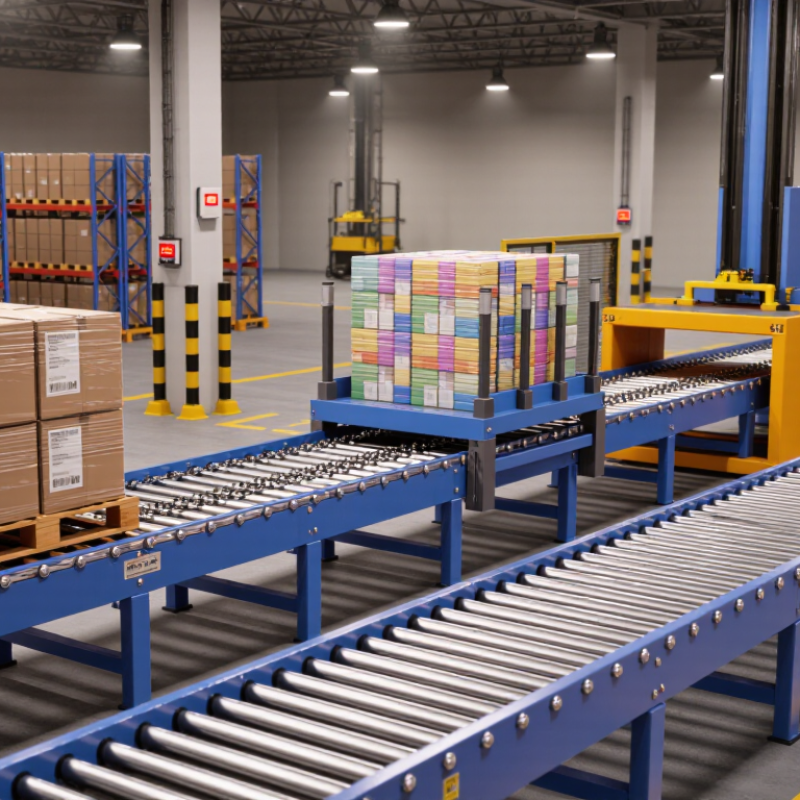
| Conveyor type | Straight transport, transfer, merge, turn, lift, or positioning function | Roller conveyors suit stable pallet bottoms; chain conveyors are useful for cross-transfer and pallets with unsuitable roller contact surfaces. | Combine roller, chain, turntable, lift, or shuttle sections according to the required material flow and layout constraints. |
| Layout and elevation | Straight-line distance, turns, inclines, declines, floor space, and access aisles | Inclines require sufficient traction and load retention; turns require adequate pallet clearance and controlled guidance. | Confirm floor loading, structural supports, service access, emergency egress, and forklift interaction before final selection. |
| Operating environment | Temperature, moisture, dust, washdown, corrosion, and indoor or outdoor use | Wet or corrosive areas require suitable materials, seals, finishes, electrical protection, and drainage provisions. | Specify corrosion-resistant components, appropriate enclosure ratings, washdown compatibility, and protection for sensors and drives. |
| Control and integration | Manual, semi-automatic, or automatic operation; required system interfaces | Typical interfaces may include barcode or RFID identification, warehouse control software, sensors, and programmable controllers. | Define communication protocols, pallet tracking logic, fault handling, manual override, and data collection requirements early. |
| Safety requirements | Guarding, pinch points, emergency stops, pedestrian crossings, and access control | Risk assessment should address moving parts, unexpected restart, falling loads, and interaction with people or vehicles. | Include accessible emergency-stop devices, guarding where needed, warning indicators, safe maintenance access, and documented procedures. |
| Maintenance and lifecycle | Cleaning, lubrication, spare parts, inspection frequency, and expected availability | Wear items commonly include rollers, chains, sprockets, bearings, belts, sensors, and drive components. | Prioritize accessible components, condition monitoring, standard spare parts, preventive maintenance, and clear fault diagnostics. |
| Future capacity | Expected growth, new pallet sizes, additional lines, and layout expansion | A conveyor designed only for current average demand may become a bottleneck during seasonal or business growth. | Reserve electrical capacity, control-system flexibility, floor space, and modular connection points for future expansion. |