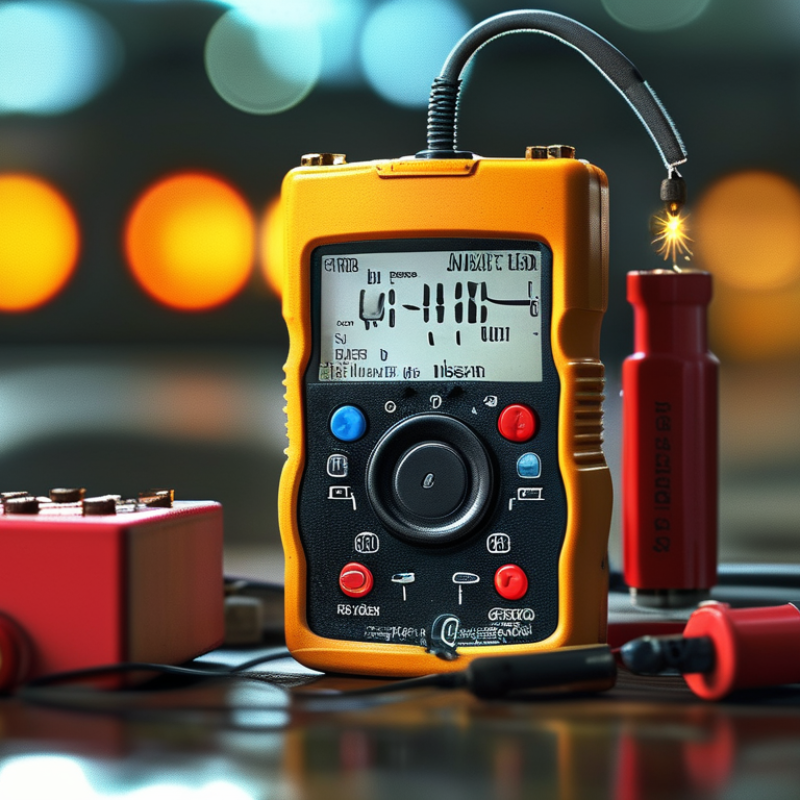
| Digital Multimeter | Open-circuit voltage | Turn the vehicle off, allow the battery to rest, select DC voltage, and connect the red probe to positive and the black probe to negative. | Approximately 12.6–12.8 V usually indicates a fully charged 12 V lead-acid battery. About 12.4 V is roughly 75% charged, while about 12.2 V is roughly 50% charged. | Quick charging-state checks and charging-system diagnosis. | Voltage alone cannot reliably show battery capacity or internal damage. Surface charge may cause a temporarily high reading. |
| Electronic Conductance Tester | Estimated starting ability and battery health through electrical conductance | Enter the battery rating shown on the case, select the correct battery type if required, and connect the clamps with the correct polarity. | The display commonly reports measured rating, estimated starting capacity, state of charge, and a condition such as “good,” “recharge,” or “replace.” | Fast non-load testing on conventional, AGM, and other supported battery designs. | Results depend on correct battery-type and rating settings. A low state of charge can produce an inaccurate or misleading condition result. |
| Carbon-Pile Load Tester | Voltage behavior under a controlled electrical load | Fully charge the battery, connect the tester correctly, apply a load for the specified period, and observe the voltage without exceeding the tester’s rating. | For a 12 V battery tested near room temperature, voltage that remains at or above about 9.6 V during a 15-second load test is commonly considered acceptable. Temperature and test specifications affect the limit. | Assessing cranking performance and identifying weak batteries under load. | Produces heat, draws substantial current, and can stress a damaged battery. It is unsuitable when the battery is frozen, leaking, visibly swollen, or severely discharged. |
| Battery Hydrometer | Specific gravity of electrolyte in each cell | Remove the vent caps only on serviceable flooded batteries, draw electrolyte into the hydrometer, and compare cell readings at the specified temperature. | A fully charged flooded cell is often near 1.265 specific gravity at approximately 25°C. A difference of about 0.050 or more between cells may indicate an internal problem. | Detailed cell-by-cell checks on serviceable flooded lead-acid batteries. | Not suitable for sealed, AGM, or gel batteries. Electrolyte is corrosive and readings require temperature correction. |
| Starter and Charging System Tester | Battery voltage during starting and alternator output while running | Connect the tester to the battery, record the resting voltage, observe the lowest voltage during engine cranking, and measure voltage with the engine running. | During cranking, a healthy 12 V system commonly stays above about 9.6 V at room temperature. Running voltage is often approximately 13.5–14.8 V, depending on vehicle design and operating conditions. | Separating battery problems from starter or charging-system problems. | Modern vehicles may use variable charging voltage, so a single running-voltage value is not always conclusive. |