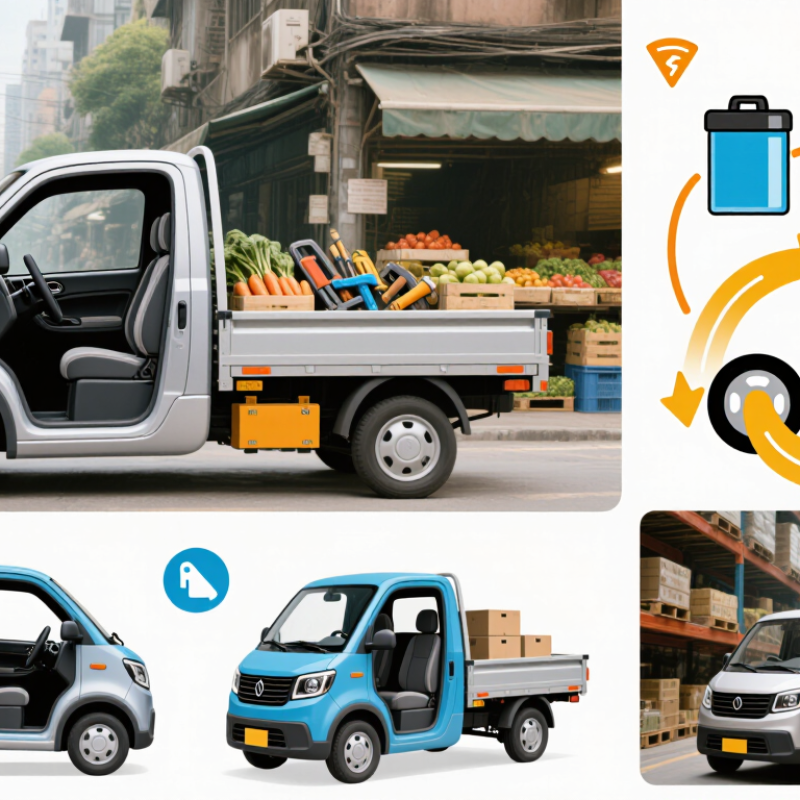
| Basic definition | A tiny electric truck is a compact, battery-powered work vehicle with a cab and a cargo bed or utility body. The term is descriptive, not one universal vehicle class, so size, equipment, and legal classification vary. | Short-distance transport of tools, supplies, produce, waste, or light cargo. | Its small footprint can make it easier to maneuver and park than a full-size truck. | “Tiny electric truck” alone does not specify road legality, payload, crash protection, or performance. |
| Electric drivetrain | A rechargeable battery supplies electricity to a motor through power electronics. The motor turns the wheels, commonly through a simple reduction gear or drivetrain. | Frequent stop-and-go work around campuses, facilities, farms, and other defined sites. | Electric motors provide propulsion without tailpipe emissions and are generally quiet during operation. | Overall environmental impact depends on electricity generation, battery production, and vehicle use. |
| Battery and charging | The battery stores energy for driving and onboard equipment. Charging time depends on battery capacity, charger power, charging conditions, and the vehicle’s charging system. | Vehicles that return to a depot or workplace can often be charged between shifts or overnight. | Charging at a regular work location can reduce visits to fuel stations. | Charging requires access to suitable electrical supply; downtime and cold or hot conditions can affect operations. |
| Controls and energy use | A controller regulates power from the battery to the motor in response to driver input. Some vehicles also use regenerative braking to recover a portion of energy while slowing. | Low-speed routes with repeated stops, where controlled acceleration and braking are useful. | Fewer conventional engine-related service needs may reduce routine maintenance tasks. | Regenerative braking is not available on every model and does not recover all braking energy. |
| Cargo capacity | Payload and bed volume are set by the vehicle’s design. The rated payload includes cargo and may also be affected by passengers, accessories, and other loads. | Moving smaller loads, equipment, and supplies over short routes. | A purpose-built bed can make loading and unloading work materials convenient. | Payload and cargo space are usually more limited than those of larger work trucks. Loads must stay within the vehicle’s ratings. |
| Typical operating range | Range varies with battery size, load, speed, terrain, temperature, driving style, and use of heating or other accessories. | Predictable local routes where daily distance and charging opportunities can be planned. | Regular routes make it easier to estimate energy needs and schedule charging. | Published range is not a guarantee of real-world range; long trips or heavy loads may require careful planning. |
| Common work settings | Compact electric utility trucks are used in some controlled or local environments, depending on their design and legal approval. | Large properties, warehouses, campuses, resorts, farms, municipal facilities, and neighborhood-scale services. | They can suit repeated short trips where compact size and low-noise operation are useful. | They may not suit highway travel, long-distance hauling, steep routes, or heavy-duty work. |
| Road use and safety | Road access depends on the vehicle’s certification, equipment, registration, and the laws in the place where it is driven. Some compact electric vehicles are designed for restricted-speed use; others may meet different vehicle standards. | Private sites or public roads where the specific vehicle is permitted. | Choosing a vehicle suited to the route and work can support practical local transport. | Do not assume a small electric truck is street-legal or suitable for every road. Check local rules and vehicle documentation. |
| Best-fit decision | Compare the rated payload, usable range, charging setup, route conditions, safety equipment, and legal classification with the intended task. | Operations with modest loads, short distances, and reliable access to charging. | A close match between vehicle capability and daily work can make the vehicle efficient for its role. | A poor match may lead to insufficient range, overloading, charging delays, or restrictions on where it can operate. |