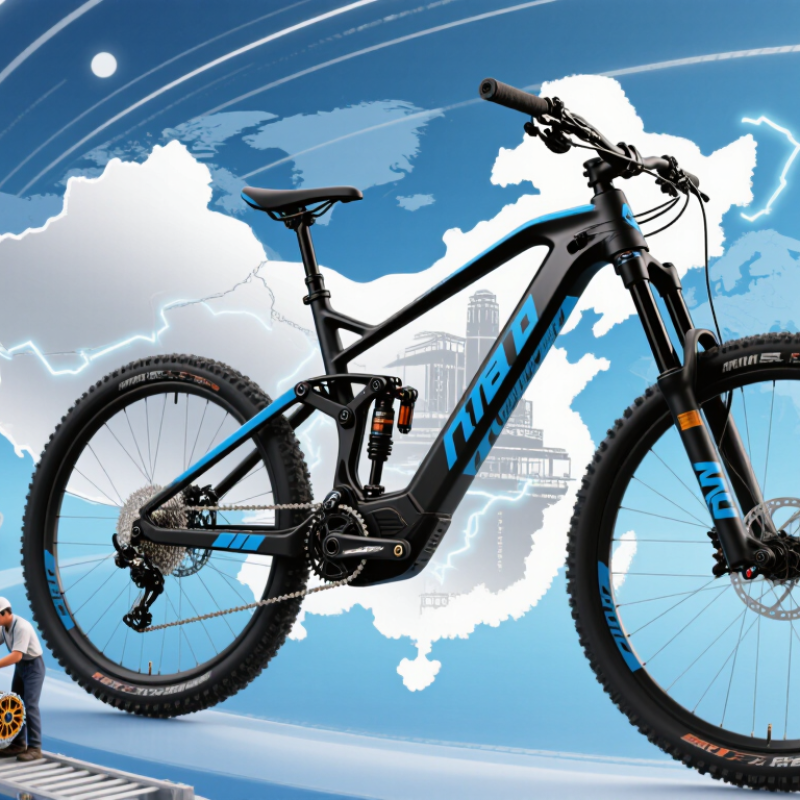
| China’s manufacturing position | China is the world’s largest manufacturing and export base for electric bicycles and related light electric vehicles, supported by mature frame, motor, controller, battery, and component supply chains. | Buyers can commonly source complete bikes and major subsystems from one industrial ecosystem, which can shorten development and procurement cycles. | International Energy Agency |
| Primary production clusters | Major Chinese bicycle and light electric vehicle production is concentrated in coastal manufacturing regions, including the Pearl River Delta, Yangtze River Delta, and Tianjin area. | Regional clustering improves access to machining, aluminum or carbon frame production, battery assembly, suspension components, packaging, and export logistics. | Chinese Government Information |
| Typical trail-bike drive systems | Electric trail bikes generally use either a mid-drive motor for centralized weight distribution and climbing performance or a hub motor for simpler construction and lower system cost. | Supplier comparison should include torque delivery, thermal management, controller tuning, noise level, serviceability, and compatibility with the intended market. | Technical classification based on standard bicycle powertrain architectures |
| EU pedal-assist limit | For an EU EPAC classification, the motor’s maximum continuous rated power must not exceed 250 W, and motor assistance must progressively reduce and cut off before the bicycle reaches 25 km/h. | Suppliers targeting the European Union must provide compliant firmware, motor ratings, labeling, technical documentation, and conformity support. | EU Regulation 168/2013 |
| Battery transport compliance | Lithium-ion batteries shipped by air must comply with applicable dangerous-goods rules, including UN 38.3 transport testing and packaging requirements. | A capable supplier should be able to provide UN 38.3 test evidence, battery specifications, safety data, packaging instructions, and shipment documentation. | UN Manual of Tests and Criteria |
| Battery safety standard | IEC 62133-2 specifies safety requirements and tests for portable sealed secondary lithium cells and batteries under intended use and foreseeable misuse conditions. | Battery pack design, cell selection, protection circuits, enclosure construction, and test documentation should be reviewed during supplier qualification. | International Electrotechnical Commission |
| Bicycle structural safety | ISO 4210 establishes safety and performance requirements and test methods for bicycles, including frames, forks, steering systems, wheels, brakes, and other components. | Trail-bike suppliers should demonstrate frame fatigue testing, brake performance, wheel durability, and component validation for off-road loads. | ISO 4210 Bicycle Safety Standard |
| Off-road durability priorities | Electric trail bikes require higher resistance to vibration, impacts, water exposure, mud, repeated braking, and thermal loads than ordinary urban bicycles. | Supplier audits should examine suspension mounting points, motor protection, cable routing, battery retention, sealing, weld quality, and spare-parts availability. | Application-specific engineering and validation criteria |
| Water and dust protection | Ingress protection ratings are defined by IEC 60529. The first digit addresses solid-particle protection and the second digit addresses water protection. | Suppliers should state the tested IP rating for the battery, motor, display, controller, and connectors rather than using general claims such as “waterproof.” | IEC 60529 IP Ratings |
| Export documentation | Common international shipment documents include commercial invoices, packing lists, transport documents, product specifications, battery declarations, and destination-market conformity records. | Suppliers with established export procedures can reduce customs delays and improve regulatory traceability for complete bikes and separate battery shipments. | World Customs Organization |
| Supplier evaluation indicators | Key evaluation indicators include prototype capability, documented testing, battery traceability, quality-control procedures, production consistency, minimum order quantity, warranty terms, and after-sales support. | These criteria provide a practical, brand-neutral method for comparing Chinese suppliers without relying solely on quoted unit price. | Standard international sourcing and supplier-audit practice |
| Main competitive advantages | China offers broad component availability, experienced electric-bicycle assembly capacity, flexible customization, established tooling resources, and mature export logistics. | These advantages are especially relevant for private-label development, platform-based models, multiple battery configurations, and cost-sensitive international programs. | Industry supply-chain assessment |
| Main sourcing risks | Potential risks include inconsistent battery-cell traceability, incomplete certification files, varying quality between production batches, software restrictions, spare-parts gaps, and unclear warranty responsibilities. | Independent factory audits, sample testing, written specifications, inspection plans, and legally clear contracts are recommended before mass production. | International procurement risk-control practice |