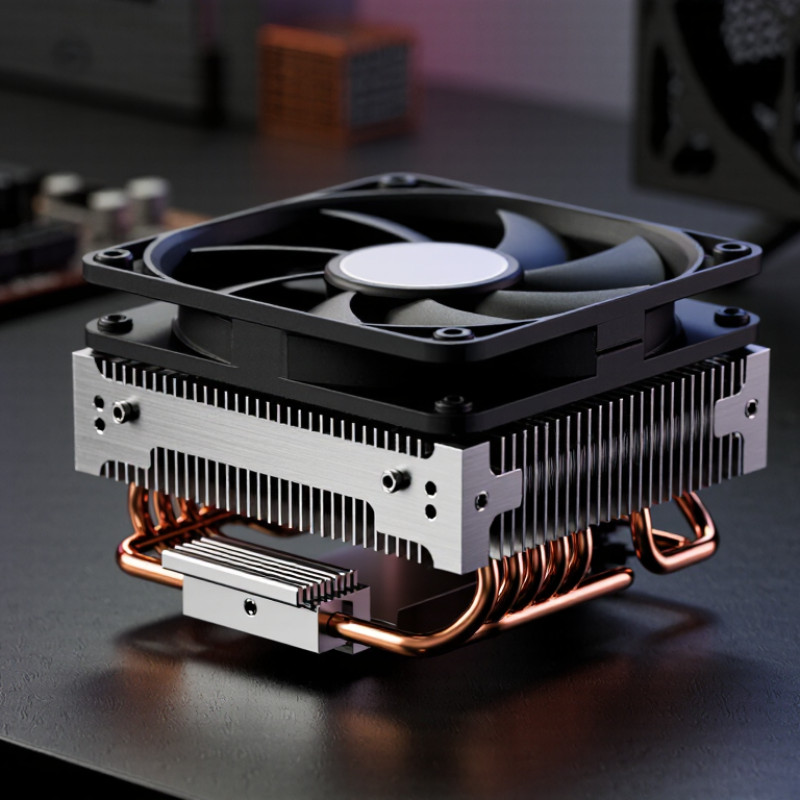
| Definition | A low-profile CPU cooler is designed with a reduced overall height compared with conventional tower coolers, primarily for compact desktop, Mini-ITX, small-form-factor, and horizontal-case systems. | Limited case clearance is the main reason for selecting this cooler type. | Provide accurate height drawings, mounting diagrams, and case-clearance guidance. | Compare the published cooler height with the CPU-case clearance specification. |
| Overall Height | Common product range: approximately 30–75 mm; exact height varies by heatsink, fan, and mounting design. | Even a few millimeters can determine whether the cooler fits inside a compact enclosure. | Maintain dimensional tolerances and provide pre-production samples for measurement. | Measure from the CPU contact surface to the highest point of the assembled cooler. |
| Cooling Architecture | Common designs include horizontal top-flow heatsinks, radial fin coolers, and compact heatpipe-assisted assemblies. | Top-flow designs can cool nearby motherboard components, while heatpipes may improve heat transfer within a compact structure. | Offer multiple fin layouts and thermal solutions for different height and noise requirements. | Review thermal test reports and the mechanical design drawing. |
| Compatible CPU Power Level | Typical practical range: about 35–95 W processor thermal design power, depending on cooler size, airflow, ambient temperature, and sustained workload. | Nominal CPU power ratings are not universal performance guarantees. | State tested operating conditions instead of using an unsupported universal TDP claim. | Check test data, ambient temperature, fan speed, processor settings, and workload duration. |
| Socket Support | Compatibility depends on the mounting kit and may include current desktop CPU socket families, subject to mechanical clearance and backplate requirements. | A cooler may fit one socket mechanically but still interfere with memory, VRM heatsinks, or the case. | Supply interchangeable mounting hardware and an updated compatibility list. | Confirm socket hole spacing, backplate dimensions, retention pressure, and motherboard clearance. |
| Fan Size | Common fan formats include approximately 80 mm, 92 mm, and 120 mm; larger fans can move air at lower rotational speeds when space permits. | Fan diameter affects airflow, acoustic performance, power consumption, and cooler height. | Provide reliable fan sourcing, balanced blades, PWM control, and replaceable fan options. | Review fan dimensions, rated speed range, connector type, airflow, and noise test conditions. |
| Fan Speed Control | Four-pin PWM control is widely used for automatic speed adjustment through the motherboard. | Automatic control can reduce noise during light workloads and increase cooling performance under load. | Use a stable PWM motor and publish the minimum and maximum operating speeds. | Test startup behavior, speed range, PWM response, and operation at different loads. |
| Noise Performance | Typical published noise figures may range from roughly 20–35 dBA, but results depend strongly on fan speed, test distance, and enclosure acoustics. | Noise data from different suppliers is not directly comparable without consistent test conditions. | Provide standardized acoustic test conditions and avoid unsupported silent-operation claims. | Confirm measurement distance, room noise, fan speed, and whether the result is measured or calculated. |
| Heatsink Materials | Aluminum fins are common; copper contact plates or heatpipes may be added to improve heat transfer. | Material selection affects thermal conductivity, weight, cost, and corrosion resistance. | Document material grades, surface treatment, soldering or bonding process, and dimensional consistency. | Review material declarations, process records, and sample cross-sections where required. |
| Thermal Interface Material | Coolers may be supplied with pre-applied or separately packaged thermal compound. | Thermal compound quality and application thickness influence contact resistance. | Specify compound type, shelf life, application method, and replacement availability. | Check technical data sheets, batch information, and thermal resistance test results. |
| Clearance Compatibility | Important clearances include CPU cooler height, memory-module height, motherboard heatsink position, PCIe area, and power-cable routing. | Compact systems have less tolerance for mechanical interference. | Provide 2D drawings, 3D models, and a clearance matrix for common compact layouts. | Perform a physical fit test with the target motherboard, memory, and enclosure. |
| Power Connection | Most desktop CPU fans use a low-voltage motherboard fan header, commonly with a four-pin PWM connector. | Correct electrical specifications help prevent startup failures and motherboard-header overload. | Publish rated voltage, current, connector pinout, and cable length. | Verify current draw, startup current, connector retention, and PWM compatibility. |
| Reliability Testing | Relevant checks include fan endurance, thermal cycling, vibration, abnormal noise, connector durability, and mounting-cycle tests. | Compact computers may operate continuously with limited airflow, increasing the importance of reliability. | Maintain documented quality-control procedures and traceable batch records. | Request test plans, acceptance criteria, sample reports, and corrective-action records. |
| Customization Support | Possible options include dimensions, fin geometry, fan configuration, mounting hardware, cable length, surface finish, and packaging. | Customization can help match a specific chassis, processor power target, or system integrator requirement. | Provide engineering drawings, prototype validation, tooling control, and engineering-change management. | Approve a golden sample and compare mass-production units against the approved specification. |
| Packaging and Shipping | Protective packaging should prevent fin deformation, fan damage, loose mounting hardware, and thermal-compound contamination. | Small fins and fan assemblies can be damaged by compression and impact during transport. | Use drop-tested packaging, labeled accessory compartments, and moisture-resistant protection where appropriate. | Conduct packaging inspection, vibration testing, and controlled drop testing. |
| Supplier Selection Priority | Prioritize verified thermal performance, mechanical fit, quality consistency, documentation, production capacity, and after-sales support. | The lowest unit price does not necessarily provide the best total cost or system reliability. | Offer engineering samples, transparent specifications, stable lead times, and responsive technical support. | Use a weighted supplier scorecard based on tested evidence rather than marketing claims. |