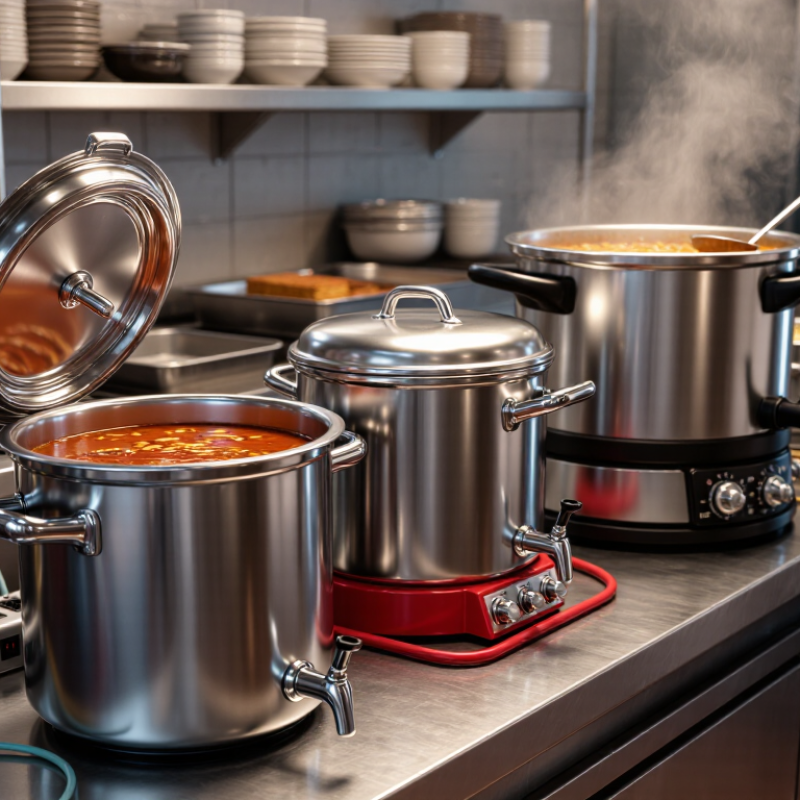
For global buyers, 304 stainless steel remains a practical baseline for soup kettles.
It typically contains about 18% chromium and 8% nickel, supporting corrosion resistance around salty broths and acidic ingredients. World Stainless reported approximately 58.4 million tonnes of crude stainless steel production in 2023, showing the material’s broad industrial importance. However, production volume does not prove equipment quality.
Look closely at the cooking interior. The U.S. FDA Food Code 2022 requires food-contact surfaces to be smooth, corrosion-resistant, and easily cleanable. Buyers should request food-grade interior documentation, weld inspection details, and surface-finish specifications.
Rough seams can trap soup residue. That is a small detail, but cleaning teams notice it daily.
Double walls improve thermal stability and reduce heat escaping from the kettle.
Performance depends on insulation thickness, lid fit, and heating control, not the phrase “double wall” alone. A 2023 U.S. Department of Energy report highlights insulation as a key factor in reducing heat transfer across equipment systems. The principle applies here, although kitchen conditions are less controlled.
Some sellers overstate efficiency. Ask for test temperatures, holding times, and energy measurements. A shiny surface is not enough.