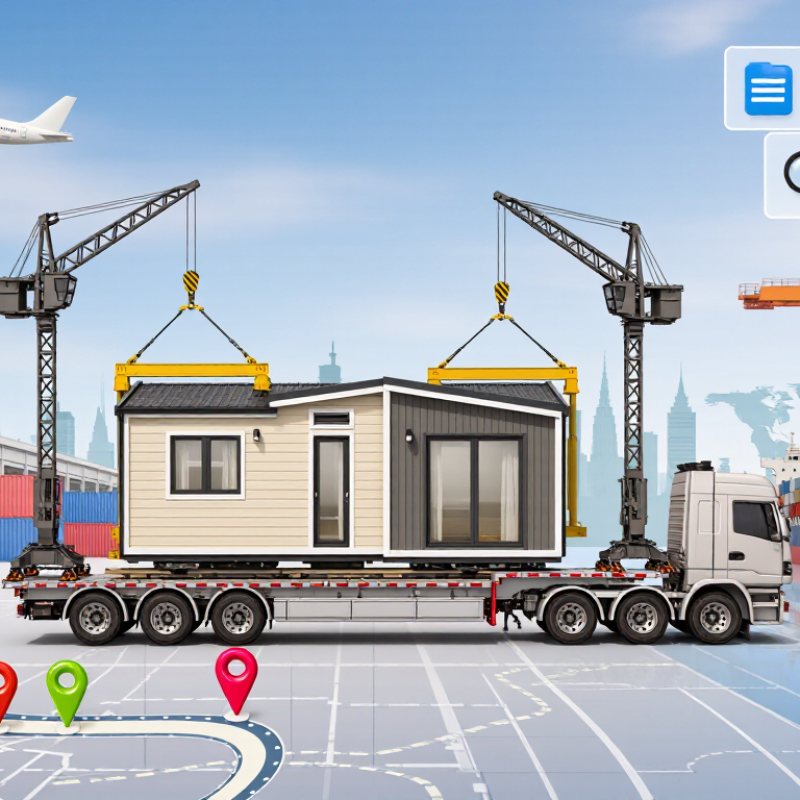
| International freight method | A complete tiny house may move by roll-on/roll-off, flat-rack, open-top container, standard container, or road transport, depending on its dimensions and whether it can be lifted. | The correct transport method affects loading equipment, seaworthy preparation, port handling, total cost, and damage exposure. | A written routing plan showing the transport mode, ports, transshipment points, lifting method, and responsibility at each handover. | International maritime logistics practice; final suitability depends on the cargo dimensions and carrier requirements. |
| Container compatibility | ISO 668 defines standardized freight-container dimensions. A nominal 20-foot container is approximately 6.06 m long externally, while a nominal 40-foot container is approximately 12.19 m long externally. | A tiny house must fit the selected equipment after accounting for doors, internal clearances, packing, lifting points, and permitted cargo overhang. | Measured length, width, height, gross weight, center of gravity, lifting points, and an equipment-fit drawing. | ISO 668:2020 |
| Road width and oversize planning | There is no single worldwide maximum road-transport width. In the European Union, a commonly referenced maximum vehicle width is 2.55 m, subject to vehicle category and national rules. In the United States, 8.5 ft (approximately 2.59 m) is a common baseline, but state rules vary. | A house that exceeds local limits may require route surveys, escort vehicles, temporary traffic controls, or special permits. | A route-specific dimensional assessment, permit responsibility statement, escort plan, and written confirmation of all oversize assumptions. | EU Directive 96/53/EC; United States state transportation regulations. |
| Gross weight and axle loading | The legal maximum is determined by the vehicle, axle configuration, road authority, bridge limits, and country-specific rules; it cannot be assessed from house weight alone. | Excessive axle loading can prevent movement even when the total gross weight appears acceptable. | A certified or documented gross weight, axle-load calculation, trailer specification, and route restrictions review. | National road-transport and bridge-load regulations; limits must be confirmed for the actual route. |
| Lifting and securing plan | Lifting operations require a known gross mass, center of gravity, rated lifting points or approved lifting accessories, and a documented load-securing method. | Improper lifting or restraint can damage chassis members, cladding, windows, utilities, and interior finishes. | A lift plan, rigging or spreader-beam specification, lashing diagram, tie-down ratings, and inspection checklist. | Applicable port, lifting-equipment, and cargo-securing rules; requirements vary by jurisdiction and carrier. |
| Customs documentation | International shipments commonly require a commercial invoice, packing list, transport document, origin information, customs classification, and import permits where applicable. | Incomplete or inconsistent documentation can cause customs holds, storage charges, re-export problems, or unexpected duties. | A document checklist identifying who prepares each document, who acts as importer of record, and which party pays duties and taxes. | World Customs Organization customs procedures; destination-country customs authority. |
| Incoterms clarity | Incoterms® 2020 contains 11 standardized trade terms that allocate delivery tasks, costs, and risk between buyer and seller; it does not replace a transport contract or determine ownership. | A clear term helps buyers understand whether the quotation includes export clearance, main carriage, insurance, import clearance, duties, and final delivery. | The exact Incoterms® rule, named place, cost inclusions, risk-transfer point, and exclusions shown on the quotation. | ICC Incoterms® 2020 |
| Cargo insurance | Carrier liability and cargo insurance are not automatically the same. Liability may be limited by contract, convention, weight, or jurisdiction. | A high-value custom home may have a declared value far above the carrier’s standard liability exposure. | An insurance certificate, insured value, covered risks, exclusions, deductible, claim procedure, and coverage period from pickup to final delivery. | Applicable carriage contract and insurance policy; coverage must be reviewed before loading. |
| Transit-time estimate | Ocean transit time is only one part of the schedule. Port booking, export handling, customs, transshipment, inland permits, and final delivery can materially extend the total timeline. | Buyers need a door-to-door schedule rather than a port-to-port sailing estimate. | A milestone schedule covering pickup, export clearance, port arrival, vessel departure, destination clearance, inland movement, and delivery. | The actual schedule depends on route, sailing frequency, port congestion, customs processing, and permits. |
| Destination-site access | The final delivery location must be assessed for road width, turning radius, overhead utilities, slopes, bridge limits, unloading space, and ground-bearing capacity. | A shipment can arrive safely at the destination port but still fail at the final property because the access route or unloading area is unsuitable. | A site survey, turning-path drawing, overhead-clearance check, crane or trailer setup plan, and written site-readiness requirements. | Site-specific engineering and local authority requirements. |
| Utilities and disconnection scope | Gas, water, wastewater, electrical, solar, batteries, and other systems may require professional disconnection, draining, isolation, or hazardous-goods review before movement. | Unprepared systems can create fire, leakage, contamination, battery, or customs-compliance risks. | A pre-move disconnection checklist, responsible licensed trades, system-draining record, battery declaration, and reconnection scope. | Local electrical, gas, environmental, and dangerous-goods requirements. |
| Destination compliance | Transport approval does not automatically mean the dwelling is approved for habitation. Building, zoning, foundation, fire, energy, plumbing, electrical, and occupancy rules remain destination-specific. | A legally transported tiny house may still be unusable if it cannot obtain placement or occupancy approval. | Written confirmation of which party checks local building and zoning requirements, plus a list of required certificates and inspections. | Destination-country and local-authority building and planning regulations. |
| Quotation transparency | A reliable quotation should separate origin charges, packing or preparation, export fees, ocean freight, insurance, destination charges, customs brokerage, duties and taxes, permits, escorts, unloading, and final placement. | Separating cost components makes competing international moving proposals comparable. | A line-item quotation in one currency with validity dates, fuel or exchange-rate adjustments, exclusions, cancellation terms, and possible accessorial charges. | Best practice for international freight procurement and cost comparison. |
| Claims and damage control | A documented pre-loading condition report with photographs, serial numbers, meter readings, and signed handover records creates an objective baseline for claims. | Tiny houses contain many fragile and high-value components that may not show visible damage until installation or commissioning. | A condition survey, photo inventory, handover signatures, delivery inspection window, and claims contact with response deadlines. | Cargo-claims best practice; contractual notice periods may be shorter than expected. |
| Operational capability | A suitable mover should be able to identify its role as carrier, freight forwarder, customs broker, project manager, or subcontractor and disclose the handoffs involved. | Clear accountability reduces gaps between the builder, port operator, inland carrier, customs agent, and installation crew. | Legal entity details, insurance certificates, subcontractor responsibilities, emergency contacts, and a single documented project owner. | International logistics due-diligence practice; verify licenses and registrations in the relevant jurisdictions. |