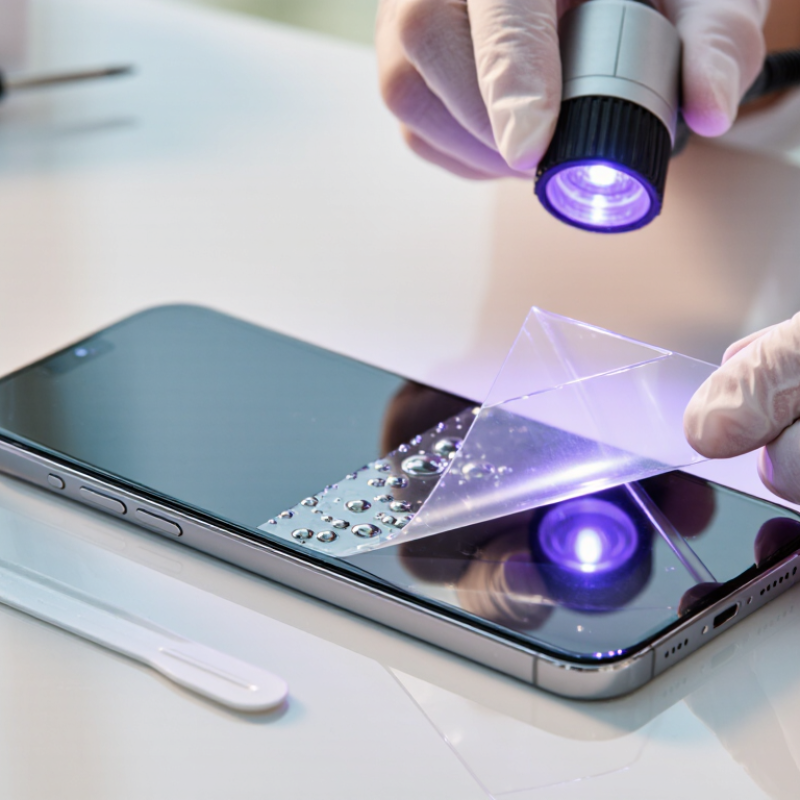
| Basic Definition | Product type | A flexible screen-protection film made from hydrogel or polymer-based material. It is designed to conform closely to flat and slightly curved displays. | Flexible protection |
| Installation | Application method | The film is positioned with a liquid adhesive or installation solution. A squeegee is used to remove excess liquid and air before curing. | Requires careful fitting |
| UV Curing | Light source | Ultraviolet light activates a photo-reactive adhesive or coating. Many systems are designed around UV-A wavelengths, commonly within approximately 365–405 nm. | System-dependent |
| UV Curing | Curing time | Initial curing commonly takes tens of seconds to a few minutes, depending on the adhesive formulation, lamp power, distance, and number of curing passes. | Follow installation instructions |
| Material Behavior | Flexibility | The soft, elastic structure can conform to curved edges more easily than many rigid glass protectors. | Good for curved screens |
| Surface Performance | Minor scratch recovery | Some hydrogel films use elastic or self-healing surface layers that can reduce the visibility of very light scratches over time. Deep cuts and punctures generally remain. | Limited self-healing |
| Touch Interaction | Touch sensitivity | A properly installed, thin film normally preserves capacitive touch operation because it does not significantly interfere with the screen’s electrical sensing layer. | Usually compatible |
| Optical Quality | Clarity and reflections | Clear versions can maintain high transparency, but surface texture, adhesive thickness, dust, or installation residue may cause haze, glare, or visible defects. | Installation-sensitive |
| Impact Protection | Resistance to drops | The film helps protect against scratches and light surface abrasion, but it generally absorbs less impact energy than a well-designed rigid tempered-glass protector. | Not a full impact shield |
| Edge Coverage | Coverage potential | Its flexibility allows broad coverage around rounded edges and areas where rigid glass may lift or leave larger gaps. | Strong coverage potential |
| Installation Risk | Bubbles and dust | Dust particles, trapped liquid, uneven pressure, or incorrect alignment can produce bubbles, streaks, edge lifting, or visible curing marks. | Higher skill requirement |
| Device Compatibility | Cases and accessories | A precisely trimmed film is usually compatible with cases, but excessive edge coverage or a tight case can push against the film and cause lifting. | Check edge clearance |
| Maintenance | Cleaning and replacement | The surface can be cleaned with a soft, lint-free cloth. Replacement may be needed when the film becomes deeply scratched, cloudy, detached, or contaminated. | Routine care required |
| Safety Consideration | UV exposure | UV curing should be performed with the recommended lamp and protective practices. Direct exposure to eyes and skin should be avoided, and the device manufacturer’s installation guidance should be followed. | Use protective practices |
| Best Use Case | Recommended priority | Suitable when flexibility, curved-edge coverage, thinness, and touch performance are more important than maximum drop-impact resistance. | Balanced daily protection |
| Main Limitation | Protection trade-off | UV hydrogel film is not a substitute for a protective case or a high-impact protector. Its performance depends strongly on material quality, installation accuracy, curing, and device design. | Performance varies |