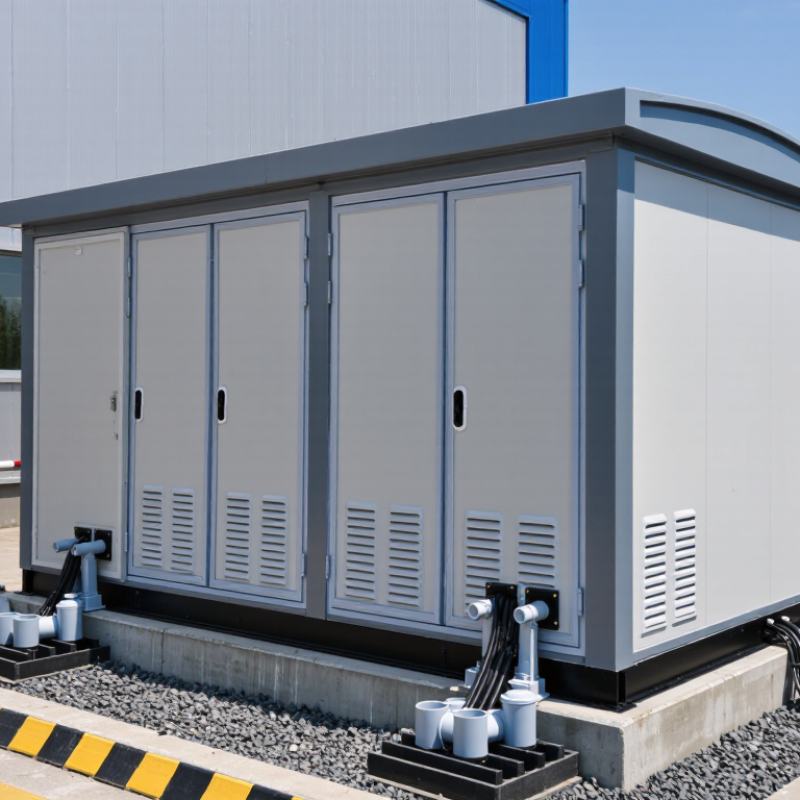
| Definition | A factory-assembled, enclosed substation that integrates medium-voltage switching, a distribution transformer, and low-voltage distribution equipment in one compact housing. | It reduces installation complexity and provides a coordinated, space-efficient power distribution unit. | The complete assembly should be selected, installed, and tested as a coordinated system rather than as unrelated components. |
| Main Sections | Usually includes a medium-voltage compartment, transformer compartment, and low-voltage compartment. | Physical separation improves safety, simplifies cable routing, and supports easier access for inspection. | Access doors, barriers, interlocks, and cable compartments must remain correctly installed and functional. |
| Primary Voltage | Common medium-voltage primary systems are in the approximately 6 kV to 36 kV range, depending on the utility or facility network. | The primary voltage determines insulation requirements, switchgear selection, clearances, and protection settings. | Verify rated voltage, power-frequency withstand, impulse withstand, and local electrical-code requirements before installation. |
| Secondary Voltage | Low-voltage outputs commonly include 400/230 V or 480/277 V systems, depending on regional practice and the connected load. | The secondary voltage must match motors, lighting, control systems, and other downstream equipment. | Check phase sequence, neutral configuration, earthing arrangement, and compatibility with connected loads. |
| Transformer Type | May use an oil-immersed transformer or a dry-type transformer. Dry-type units are often preferred indoors or where reduced liquid-fire risk is important. | The transformer type affects fire protection, ventilation, environmental requirements, noise, and maintenance practices. | Oil-filled units require checks for leaks, oil condition, pressure devices, and liquid level; dry-type units require cleaning and thermal inspection. |
| Typical Power Rating | Distribution transformer ratings commonly range from tens of kVA to several MVA. The correct rating depends on maximum demand, diversity, motor starting, and future expansion. | Correct sizing limits overheating, voltage drop, unnecessary losses, and premature insulation aging. | Review load growth and transformer loading. Sustained overloads can shorten insulation life and increase operating temperature. |
| Enclosure and Protection | Outdoor compact substations generally use a weather-resistant metal or concrete enclosure with a defined ingress-protection rating. | The enclosure protects energized equipment from dust, moisture, accidental contact, and environmental exposure. | Inspect seals, roof joints, corrosion, ventilation openings, locks, drainage, and the enclosure’s protection rating. |
| Space Requirement | The footprint is generally smaller than that of separately installed switchgear, transformer, and low-voltage panels, but exact dimensions depend on rating and layout. | A reduced footprint is useful in urban sites, factories, renewable-energy facilities, and restricted utility compounds. | Maintain required working clearances, access routes, ventilation space, lifting points, and emergency escape paths. |
| Key Benefits | Compact layout, faster site installation, reduced interconnection work, improved equipment protection, and simplified civil construction. | Factory assembly can reduce on-site wiring errors and shorten project schedules when the design is properly coordinated. | Benefits depend on correct transport, foundation preparation, cable termination, commissioning, and protection coordination. |
| Typical Applications | Industrial plants, commercial buildings, residential developments, data facilities, construction sites, transport infrastructure, solar plants, and wind farms. | The integrated format supports reliable power distribution where space, installation time, or environmental protection is important. | Application-specific requirements may include arc-flash mitigation, seismic design, coastal corrosion protection, or low-noise operation. |
| Protection Functions | Typical functions include overcurrent, short-circuit, earth-fault, transformer temperature, and low-voltage circuit protection. | Proper protection limits equipment damage and helps isolate faults while maintaining service to unaffected circuits. | Protection settings should be coordinated with upstream and downstream devices and verified through commissioning tests. |
| Routine Visual Inspection | Check for abnormal noise, odor, vibration, overheating, water ingress, dust accumulation, corrosion, loose covers, and warning-label damage. | Early detection can prevent minor defects from developing into insulation failure, fire, or unplanned outage. | Inspection frequency should be risk-based; many facilities perform routine checks monthly or quarterly, subject to site conditions. |
| Electrical Testing | Testing may include insulation resistance, winding resistance, transformer ratio, grounding continuity, breaker operation, relay function, and cable tests. | Testing confirms that insulation, switching, protection, and earthing systems remain suitable for service. | Perform tests during commissioning, after major modifications, and at intervals defined by the manufacturer, regulations, and maintenance program. |
| Thermal Monitoring | Infrared thermography can identify hot connections, overloaded conductors, poor contact pressure, and uneven phase loading while equipment is energized. | Abnormal temperature patterns often provide an early indication of connection or loading problems. | Thermal surveys should be conducted by qualified personnel under suitable load conditions and followed by de-energized corrective work. |
| Cleaning and Ventilation | Remove dust and debris, keep ventilation paths clear, and ensure cooling fans, filters, and thermostats operate correctly where fitted. | Clean and unobstructed cooling paths help control temperature and reduce contamination-related tracking. | Never clean energized high-voltage equipment. Use approved procedures and avoid compressed air that may drive contaminants into insulation. |
| Grounding and Bonding | The enclosure, transformer tank or core frame, cable screens, switchgear, and supporting steelwork should be bonded to the site grounding system. | Effective grounding helps control touch voltage and provides a path for fault current so protective devices can operate. | Inspect connections for corrosion and looseness, and measure grounding-system performance according to local requirements. |
| Safety Requirements | Use qualified electrical personnel, isolation and lockout/tagout procedures, voltage verification, appropriate personal protective equipment, and controlled access. | Compact equipment contains hazardous voltages and may present arc-flash, electric-shock, fire, and stored-energy risks. | Follow applicable electrical-safety regulations, risk assessments, operating instructions, and emergency-response procedures. |
| Relevant Standards | Commonly referenced standards include IEC 62271-202 for high-voltage/low-voltage prefabricated substations and IEC 60076 for power transformers, together with applicable national codes. | Standards define requirements for design verification, insulation, temperature rise, enclosure performance, testing, and safety. | The applicable edition and local regulations should be confirmed for each project before procurement and commissioning. |