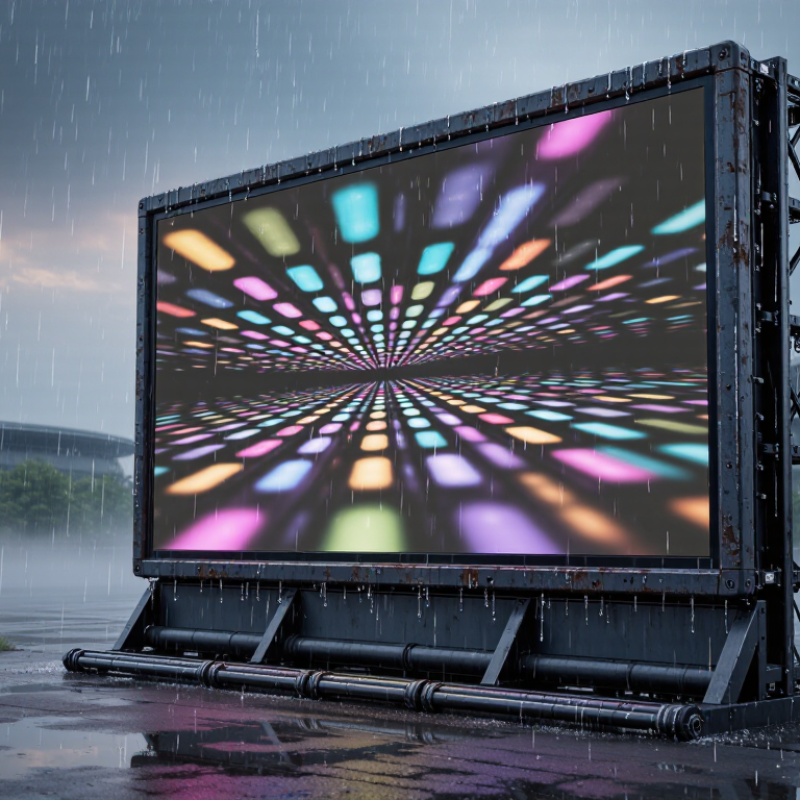
| Definition of a Waterproof Outdoor LED Screen | Weather-resistant LED display designed to operate outdoors with sealed modules, protected electronics, drainage paths, and corrosion-resistant construction. | Outdoor displays must withstand rain, dust, humidity, sunlight, and temperature changes. “Waterproof” generally describes a tested level of protection, not unlimited underwater operation. | Ingress protection is classified under IEC 60529. |
| Front Ingress Protection | IP65 is a common minimum target for outdoor LED display faces. IP66 provides higher protection against powerful water jets. | The first digit protects against dust; the second digit indicates resistance to water ingress. | IEC 60529: IP6X indicates dust-tight protection; IPX5 resists water jets and IPX6 resists powerful water jets. |
| Rear Ingress Protection | Typically IP54 to IP65, depending on cabinet design, installation position, ventilation method, and maintenance requirements. | The rear often contains power supplies, connectors, and ventilation areas, so its protection level may differ from the front. | IEC 60529 testing should specify the protected side and the complete assembled product. |
| Impact Protection | IK08 to IK10 is commonly selected for public-facing installations; the required rating depends on the risk of accidental or deliberate impact. | Impact resistance protects the cabinet, mask, front cover, and LED modules from mechanical shock. | IEC 62262 defines IK impact protection ratings. IK10 corresponds to a 20-joule impact test. |
| Pixel Pitch | Approximately 2.5–10 mm for many outdoor applications; larger pitches are often used when the viewing distance is greater. | Pixel pitch affects image resolution, viewing distance, cabinet cost, and power consumption. | Specified in millimeters as the center-to-center distance between adjacent pixels. |
| Brightness | Typically 5,000–10,000 cd/m² for direct-sunlight outdoor displays. Lower levels may be suitable for shaded locations. | Sufficient brightness improves daylight readability, while automatic dimming helps reduce glare and energy use at night. | Brightness should be measured under a defined test condition, commonly expressed in candelas per square meter. |
| Automatic Brightness Control | Ambient-light sensor with scheduled or automatic dimming; nighttime output is commonly reduced substantially from the daytime level. | Controls glare, improves visual comfort, and reduces unnecessary power consumption. | System performance depends on sensor calibration, control software, and local lighting requirements. |
| Refresh Rate | At least 1,920 Hz for general video; 3,840 Hz or higher is often preferred for camera-friendly and broadcast-related applications. | A higher refresh rate reduces visible scan lines, flicker artifacts, and rolling-band effects in camera footage. | Verify the measurement method because refresh rate and scan frequency are not identical specifications. |
| Viewing Angle | Horizontal viewing angle commonly ranges from 120° to 160°; vertical viewing angle is often about 100° to 140°. | A wide viewing angle helps maintain consistent brightness and color for audiences positioned away from the screen center. | Manufacturers should state the brightness or contrast criterion used to define the angle. |
| Color and Image Performance | True-color processing with 8-bit or higher per-channel processing; grayscale capability may reach 14–16 bits depending on the control system. | Higher processing depth supports smoother gradients, better shadow detail, and more natural transitions. | Actual image quality also depends on calibration, LED binning, receiving cards, and content processing. |
| Operating Temperature | Common design range: approximately −20°C to +50°C. Extended ranges may be available for severe climates. | Thermal design affects LED lifetime, color consistency, power-supply reliability, and startup performance. | Temperature limits should be verified for the complete system, including control equipment and power supplies. |
| Operating Humidity | Often specified at 10%–90% relative humidity, non-condensing. Condensation control may be required in humid environments. | Condensation can cause corrosion, insulation breakdown, short circuits, and optical defects. | Humidity limits should be stated together with temperature because condensation risk depends on both conditions. |
| Thermal Management | Passive heat dissipation is preferred where practical; fans, filters, or air-conditioning may be used for high-power or enclosed designs. | Efficient heat removal helps prevent thermal stress and maintains stable brightness and color performance. | Cabinet ventilation must be designed without compromising the declared ingress protection rating. |
| Power Consumption | Typical maximum consumption may be approximately 500–1,000 W/m², while average operating consumption is often lower, depending on content and brightness. | Power figures affect electrical capacity, operating cost, heat generation, and backup-power sizing. | Always distinguish maximum power from average power and identify the brightness level used for testing. |
| Electrical Protection | Common provisions include overcurrent, overvoltage, short-circuit, surge, leakage, and over-temperature protection. | Protection features reduce the risk of equipment damage caused by unstable utility power, lightning-related surges, or internal faults. | Applicable electrical and EMC requirements depend on the installation country and system configuration. |
| Grounding and Surge Protection | Protective earthing, equipotential bonding, suitable surge protective devices, and correctly rated outdoor cabling. | Outdoor metal structures and long cable runs can increase exposure to lightning-induced surges and electrical noise. | Installation should follow local electrical codes and the project’s lightning-protection design. |
| Cabinet and Material Protection | Aluminum or coated steel cabinets with sealed gaskets, treated fasteners, protected connectors, and corrosion-resistant coatings. | Material selection helps resist rust, salt mist, UV exposure, and repeated wet-dry cycles. | Coating, corrosion, and environmental tests should be selected according to the site conditions. |
| Connector and Cable Sealing | Outdoor-rated connectors, sealed cable glands, gasketed access doors, and downward-facing or protected cable entries. | Water frequently enters through connectors, cable openings, door seals, or poorly routed cables rather than through the LED surface itself. | The complete installed connection system should be tested, not only individual components. |
| Drainage and Condensation Control | Drain holes, sloped surfaces, breathable membranes, anti-condensation measures, and accessible inspection points where required. | Drainage prevents trapped water, while pressure equalization and ventilation can reduce internal condensation. | Drainage features must not create openings that invalidate the declared IP rating. |
| UV and Weather Resistance | UV-stabilized plastics, weather-resistant coatings, outdoor-rated seals, and materials selected for prolonged solar exposure. | UV degradation can cause cracking, discoloration, brittleness, seal failure, and reduced mechanical protection. | Material and accelerated weathering tests should match the expected outdoor exposure and regional climate. |
| Serviceability | Front or rear service access, replaceable LED modules and power supplies, modular data connections, and documented maintenance procedures. | Easy service reduces downtime and lowers the risk of damaging seals during repairs. | After maintenance, all gaskets, fasteners, cable glands, and covers should be correctly restored before retesting. |
| Recommended Verification | Request an IP test report for the assembled cabinet or display, electrical safety documentation, environmental test results, and installation instructions. | Marketing descriptions alone do not confirm that the complete installed screen achieves the stated protection level. | Confirm test scope, sample configuration, test conditions, date, and whether the report applies to the final product design. |