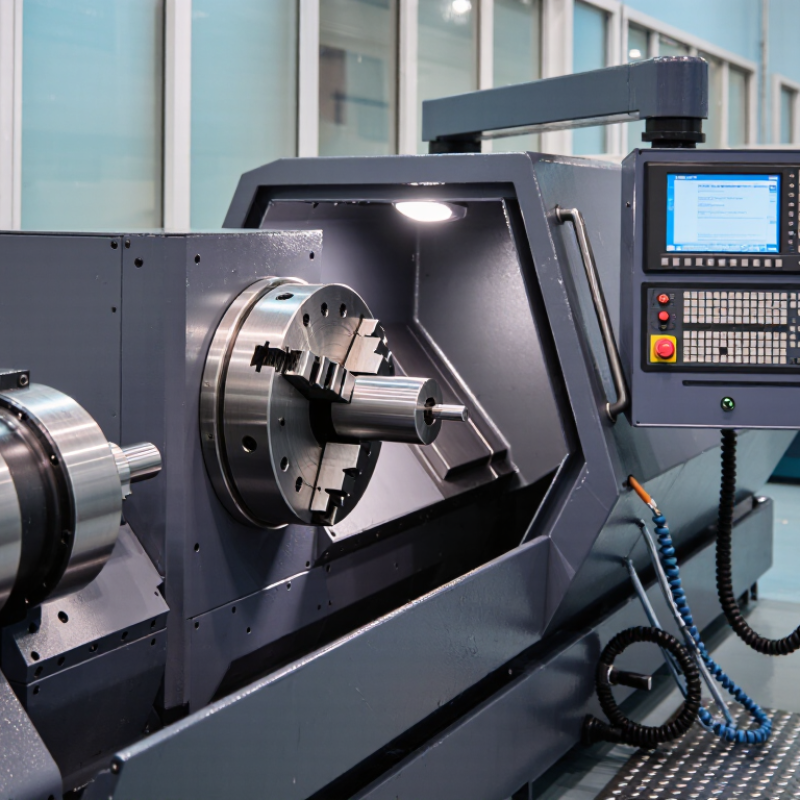
| Flat-Bed CNC Centre Lathe | 360–800 mm | 200–500 mm | 500–2,000 mm | 52–105 mm | 2,000–3,000 rpm | 7.5–30 kW | General shaft, flange, bushing, and maintenance-part production | Versatile setup, accessible work area, suitable for large and irregular workpieces | Usually slower and less rigid than a slant-bed design for intensive automated production | Low to medium |
| Slant-Bed CNC Centre Lathe | 450–700 mm | 250–450 mm | 500–1,500 mm | 52–86 mm | 3,000–4,500 rpm | 11–30 kW | Precision components, automotive parts, hydraulic parts, and repeat production | Good chip evacuation, strong rigidity, efficient tool access, and high process stability | Higher purchase cost and more complicated access for some manual operations | Medium to high |
| Economical 2-Axis CNC Centre Lathe | 300–550 mm | 180–320 mm | 300–1,000 mm | 45–80 mm | 2,500–4,000 rpm | 5.5–18.5 kW | Standard turning, facing, threading, grooving, and small-batch job-shop work | Lower investment, simple programming, and relatively easy operator training | Limited milling capability and less flexibility for complex multi-operation parts | Low to medium |
| Heavy-Duty CNC Centre Lathe | 800–1,600 mm | 500–1,200 mm | 1,000–5,000 mm | 105–260 mm | 500–1,500 rpm | 22–75 kW | Large shafts, rollers, pressure-vessel parts, mining components, and energy equipment | High structural rigidity, large workpiece capacity, and strong low-speed cutting torque | Large footprint, higher energy consumption, and slower cycle times for small components | Low to medium |
| Swiss-Type CNC Centre Lathe | 150–350 mm | 3–32 mm | 50–300 mm | Usually below 32 mm | 6,000–12,000 rpm | 3.7–15 kW | Small, slender, high-precision parts for medical, electronics, and instrument applications | Excellent support near the cutting point, reduced deflection, and efficient bar-fed production | More specialized setup, smaller workpiece range, and higher programming complexity | High |
| Y-Axis and Driven-Tool CNC Lathe | 450–700 mm | 250–450 mm | 400–1,000 mm | 52–86 mm | 3,000–5,000 rpm | 11–30 kW | Turn-mill parts requiring cross-drilling, tapping, slotting, and off-centre milling | Combines turning and milling operations, reduces setups, and improves positional consistency | Higher machine cost, more complex tooling, and greater programming requirements | Medium to high |
| Twin-Spindle CNC Centre Lathe | 400–650 mm | 200–400 mm | 300–800 mm | 42–80 mm | 3,000–5,000 rpm | 11–30 kW per spindle | Parts requiring front-and-back machining, such as fittings, connectors, and automotive components | Can complete multiple part faces in one cycle and reduce transfer or secondary operations | More expensive maintenance, complex synchronization, and higher operator skill requirements | High |
| Automatic Bar-Fed CNC Centre Lathe | 300–500 mm | 20–250 mm | 50–500 mm | 20–80 mm | 3,000–6,000 rpm | 7.5–22 kW | Long unattended runs of repeat components made from bar stock | Reduced manual loading, consistent cycle times, and improved machine utilization | Bar-feeder space and setup are required; less suitable for one-off large workpieces | Medium to high |
| Gang-Type CNC Centre Lathe | 250–450 mm | 100–300 mm | 100–600 mm | 32–65 mm | 4,000–8,000 rpm | 5.5–18.5 kW | Small precision parts, fittings, connectors, and short-cycle production | Fast tool changes, compact layout, short cycle times, and good repeatability | Limited capacity for very large parts and fewer tooling options than a turret machine | Medium to high |
| Turret-Type CNC Centre Lathe | 400–650 mm | 200–400 mm | 300–1,200 mm | 52–86 mm | 2,500–4,500 rpm | 7.5–30 kW | Mixed production involving turning, boring, threading, grooving, and drilling | Broad tooling capacity, flexible process planning, and suitability for varied part families | Turret indexing time and tooling cost can increase when parts require only simple operations | Low to high |