Why Choose an M8 Fisheye Lens for Your Project?
Choosing the right compact lens can determine whether a small camera captures useful evidence or distorted clutter. A M8 Fisheye Lens offers an unusually broad field of view in a tiny optical package. It can monitor a doorway, robotic workspace, vehicle cabin, or retail corner with fewer blind spots. That practical advantage matters where enclosure size, wiring space, and installation time are limited.
Industry demand supports this direction. MarketsandMarkets projects the machine vision market to grow from approximately USD 13.2 billion in 2024 to USD 20.9 billion by 2029. Its analysis links growth to automation, inspection, and intelligent cameras. Grand View Research also identifies industrial automation and quality control as major machine vision applications. These reports do not prove that every project needs fisheye optics. They show why compact, wide-view imaging deserves careful evaluation.
Terminology requires attention. “M8” may describe an M8 thread, an 8-millimeter format, or a supplier’s product label. Verify the mount, sensor coverage, focal length, distortion profile, and working distance before ordering. A 180-degree image sounds impressive. It may still lose edge detail. In field testing, check faces, labels, floor edges, and bright windows under real lighting. Lens charts are useful, but installation reality can be less polite. The best choice balances coverage, resolution, distortion, and calibration effort. This article explains when an M8 Fisheye Lens makes engineering and commercial sense, while recognizing that compact does not automatically mean superior.
What Is an M8 Fisheye Lens?
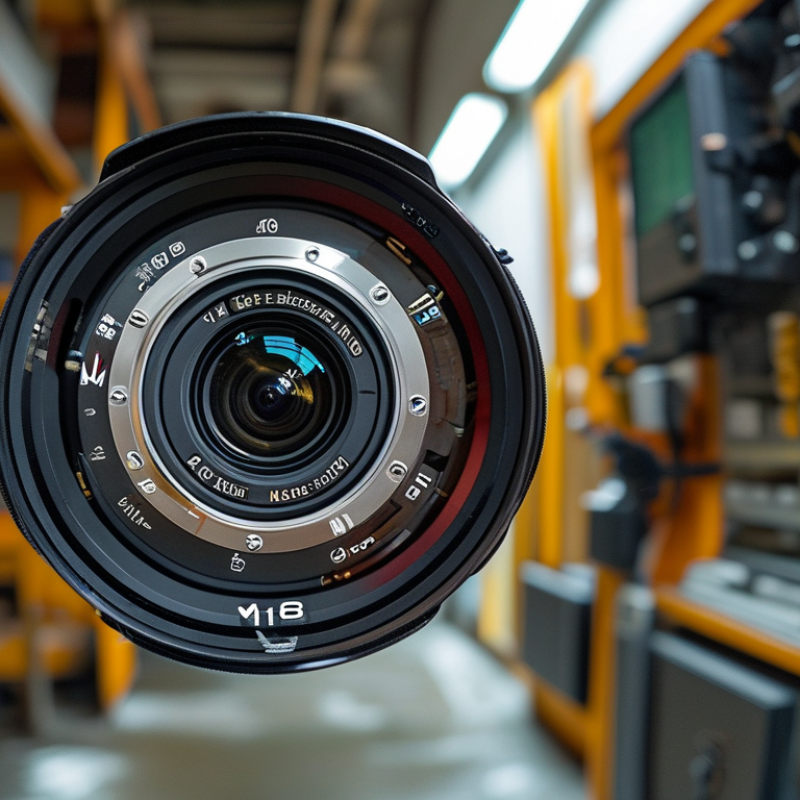
An M8 fisheye lens is a miniature lens designed for extremely wide-angle imaging. The term M8 usually describes its threaded barrel, often around 8 millimeters in diameter. It does not automatically define the lens’s focal length or viewing angle. Thread pitch can also vary, so checking the mechanical drawing is essential. A fisheye design bends straight lines near the frame edges. This creates a rounded, expanded view.
In a compact camera module, the lens sits close to a small image sensor. Its short focal length captures more of a room, vehicle interior, inspection area, or wearable device scene. However, the sensor must match the lens’s image circle. Otherwise, dark corners may appear. Aperture, working distance, and infrared performance also affect the final image. These details are easy to overlook during early selection.
Practical testing should include a grid chart and real operating light. Look for edge blur, color shifts, focus consistency, and unwanted reflections. An M8 fisheye lens can make a narrow space feel much larger. It can also exaggerate faces and bend structural lines. That effect is useful for coverage, but not always suitable for measurement. A wider field of view is not automatically better. The first prototype may reveal problems that specifications fail to show.
How the M8 Fisheye Lens Works
Why Choose an M8 Fisheye Lens for Your Project?
How the M8 Fisheye Lens Works
In many project specifications, an M8 fisheye lens means an 8 mm focal-length lens. Its short focal length captures a much wider field of view than standard lenses. Light enters through a strongly curved optical design. The lens bends peripheral rays toward the image sensor. This creates a broad image, often with noticeable barrel distortion. Very wide coverage.
That geometry suits compact cameras, mobile robots, indoor monitoring, and panoramic imaging. According to Grand View Research’s 2024 machine vision report, the global market reached about USD 17.2 billion in 2023. It is expected to grow at roughly 7.6% annually through 2030. Fortune Business Insights reported a global video surveillance market value of USD 54.32 billion in 2023. These figures show why compact, wide-view imaging remains important.
In practice, mounting distance changes the result significantly. A nearby wall may curve dramatically near the frame edge. A checkerboard calibration test can correct much of this distortion. However, correction may reduce usable resolution. Engineers should also check aperture, sensor size, corner brightness, and working distance. An 8 mm lens is not automatically the best choice. I would test real scenes before approving the design. That step is often skipped.
Project Applications for M8 Fisheye Lenses
Why Choose an M8 Fisheye Lens for Your Project?
Project Applications for M8 Fisheye Lenses
An M8 fisheye lens suits projects needing a wide view from a compact camera module. Its small mount supports embedded devices, portable instruments, and tight mechanical layouts. In indoor monitoring, one lens can cover a room corner with fewer blind spots. This may reduce camera count and simplify installation. However, edge distortion remains visible. Plan for it.
Robotics teams can use M8 fisheye lenses for navigation, obstacle awareness, and workspace observation. A mobile robot may need a broad view near floor level. The lens can capture nearby objects that narrow lenses often miss. Software calibration should correct curved lines before measurement tasks. Without calibration, distance estimates may become unreliable. Test carefully.
These lenses also work well in compact inspection systems. A technician can observe a small enclosure, production area, or equipment cabinet through a limited opening. The wide perspective helps during setup and maintenance. In practical testing, lighting often matters more than expected. Strong reflections can hide surface defects. Add controlled illumination and check sample images at the real working distance. I would not choose a fisheye lens for precise dimensional inspection without supporting optics. That limitation deserves attention.
Why Choose an M8 Fisheye Lens for Your Project?
An M8 fisheye lens is well suited to compact camera systems that need a wide viewing area with minimal installation space. The chart below shows typical target horizontal fields of view for common project applications.
How to read the chart: Applications requiring approximately 160°–180° coverage benefit most from fisheye optics, while projects near 100°–140° may use a moderate wide-angle design depending on distortion and image-detail requirements.