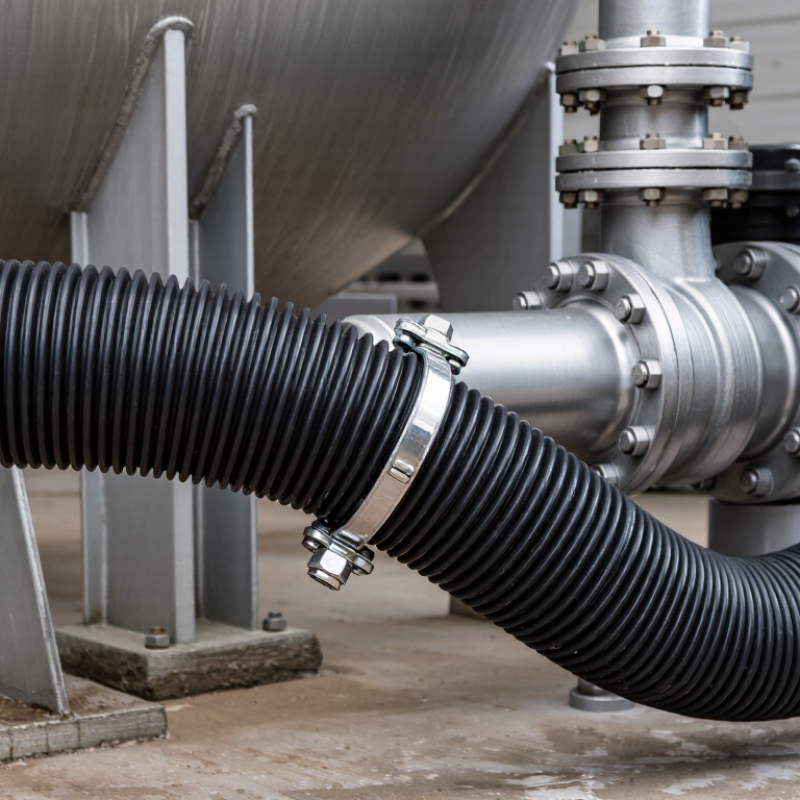
| Basic Definition | A corrugated suction hose is a flexible hose with a ribbed or convoluted outer wall, usually supported by embedded reinforcement or a helical structure. | The reinforced construction helps the hose resist collapse when conveying liquids, slurries, air, or bulk materials under suction. | Confirm that the hose is specifically rated for suction or vacuum service rather than pressure-only discharge service. |
| Common Construction | Common materials include PVC, thermoplastic polyurethane, rubber, and composite constructions. Reinforcement may include a rigid helix, textile layers, or wire. | Different constructions balance chemical resistance, flexibility, abrasion resistance, weight, and temperature capability. | Match the liner and reinforcement to the conveyed medium and operating environment. |
| Vacuum Resistance | Many reinforced industrial suction hoses are designed for partial to high vacuum service; the exact rating is commonly stated in bar, kPa, or inches of mercury. | Vacuum resistance reduces the risk of hose flattening, flow restriction, and process interruption. | Use the published vacuum rating at the actual temperature, hose length, diameter, and bend configuration. |
| Flexibility | The corrugated profile allows repeated bending and routing around equipment more easily than a rigid pipe or smooth-wall hose of similar construction. | Improves installation in confined spaces and helps accommodate equipment movement and vibration. | Do not exceed the stated minimum bend radius, especially near couplings and under vacuum. |
| Typical Inside Diameter Range | Industrial suction hoses are commonly available in nominal inside diameters from about 25 mm to more than 300 mm, depending on the application. | Provides options for low-flow transfer, pump suction, tank emptying, dewatering, dust collection, and bulk-material handling. | Size the inside diameter to control velocity, pressure loss, pump requirements, and the size of any solids being conveyed. |
| Temperature Capability | Temperature limits vary widely: general PVC types may be suitable for moderate temperatures, while specialized rubber or thermoplastic hoses can support broader ranges. | Correct temperature selection helps prevent softening, embrittlement, liner damage, and loss of vacuum performance. | Evaluate both continuous and intermittent temperature, including heat generated by the conveyed material or surrounding equipment. |
| Abrasion Resistance | Reinforced rubber and polyurethane-lined designs generally provide better resistance to abrasive solids than basic flexible PVC designs. | Helps extend service life when handling sand, gravel, powders, pellets, sludge, or other materials with sharp or hard particles. | Choose a wear-resistant liner when the conveyed material contains solids or operates at high velocity. |
| Chemical Compatibility | Resistance depends on the hose liner, concentration, temperature, exposure time, and fluid composition. | Compatible materials reduce swelling, cracking, permeation, and contamination of the conveyed product. | Check a chemical-resistance chart for the exact fluid and operating conditions before installation. |
| Pressure Capability | Suction hoses can also have a positive-pressure rating, but pressure and vacuum ratings are separate performance limits. | Allows one hose assembly to support selected transfer operations when both ratings are suitable. | Never assume that a high vacuum rating means the hose is suitable for high discharge pressure. |
| Flow Efficiency | A corrugated interior can create more turbulence and friction than a smooth interior, particularly at high flow rates. | The flexible, collapse-resistant design may provide greater installation and suction reliability where routing is complex. | Consider smooth-bore alternatives when minimizing pressure loss is more important than flexibility and vacuum resistance. |
| Typical Applications | Applications include pump suction, water and wastewater transfer, dewatering, tank cleaning, dust extraction, slurry handling, and bulk-material conveying. | The same basic hose concept can support liquid, air, and solids-handling systems when the material and ratings are appropriate. | Verify suitability for food contact, hazardous locations, static control, or sanitary service when required. |
| Coupling and Installation | Common connection options include cam-and-groove couplings, threaded adapters, flanges, clamps, and hose-tail fittings. | Proper connections help maintain vacuum integrity and reduce leakage, hose pull-out, and unplanned downtime. | Use compatible fittings, correctly sized clamps, and support for heavy or long hose assemblies. |
| Maintenance Indicators | Inspect for flattened sections, cracks, exposed reinforcement, abrasion, chemical swelling, coupling damage, and reduced flow. | Routine inspection can identify degradation before a suction failure or fluid release occurs. | Replace the hose when structural reinforcement is damaged or when its vacuum performance no longer meets process requirements. |
| Main Advantage | A combination of flexibility, collapse resistance, and routing adaptability. | Makes corrugated suction hose a practical choice for mobile equipment, uneven layouts, and vacuum-driven transfer systems. | Choose it when installation flexibility and suction stability outweigh the lower friction typically offered by a smooth-bore hose. |