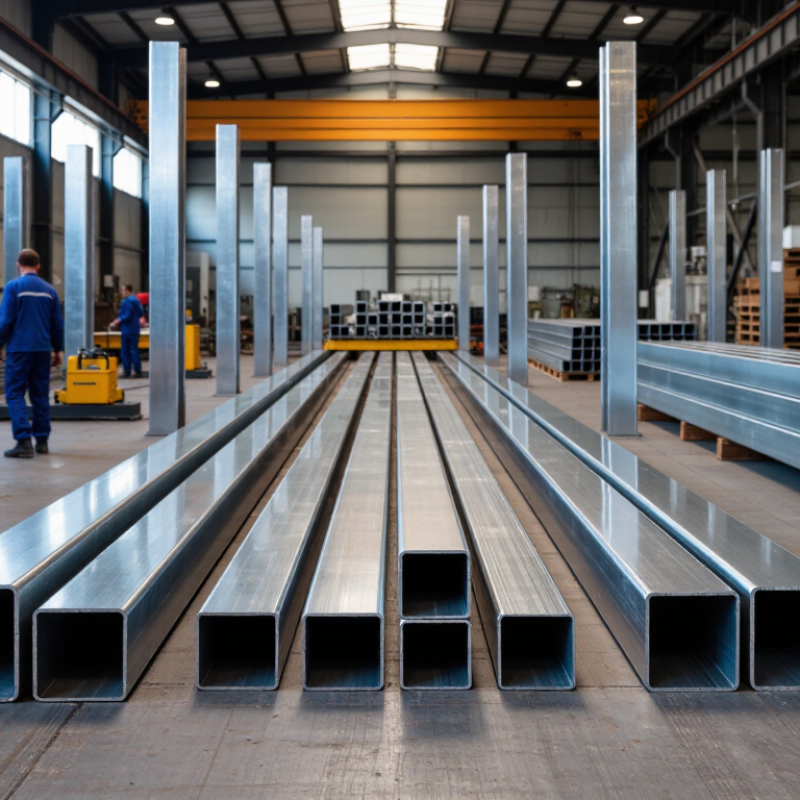
| Typical geometry used for comparison | 100 × 100 × 6 mm nominal section | 114.3 × 6 mm nominal section | Both examples use a 6 mm nominal wall thickness and are suitable for illustrating hollow-section behavior. |
| Calculated cross-sectional area | Approximately 2,256 mm² | Approximately 2,041 mm² | A larger cross-sectional area generally provides greater material availability for carrying axial force, subject to design checks. |
| Approximate mass per metre | Approximately 17.7 kg/m | Approximately 16.0 kg/m | Calculated using a nominal steel density of 7,850 kg/m³. Actual mass varies with tolerances and steel density. |
| Second moment of area about principal axes | Approximately 3.34 × 10⁶ mm⁴ about both principal axes | Approximately 3.00 × 10⁶ mm⁴ about any centroidal axis | Equal principal-axis properties make square tubes convenient where bending may occur in two perpendicular directions. |
| Section symmetry | Four-sided and symmetrical about two principal axes | Fully rotationally symmetrical | Square tubes simplify orientation, layout, and alignment; circular tubes provide uniform behavior regardless of rotational direction. |
| Connection and fabrication practicality | Flat faces support straightforward welding, bolting, cladding, and bracket attachment | Curved surfaces may require saddles, formed plates, or specialized connection details | Flat faces can reduce connection complexity in frames, modular structures, handrails, and architectural assemblies. |
| Space-efficient arrangement | Flat sides allow close placement and regular grid layouts | Gaps may occur between adjacent tubes unless special arrangements are used | Square sections can make efficient use of space in repetitive columns, frames, racks, and prefabricated modules. |
| Resistance to torsion | Closed hollow geometry provides good torsional efficiency compared with an open section of similar mass | Closed hollow geometry provides strong and uniform torsional behavior | Both profiles can be effective for bracing and members exposed to combined bending and torsion; final selection requires engineering verification. |
| Surface area for coating per metre | Approximately 0.376 m²/m for the outside perimeter of a 100 mm square | Approximately 0.359 m²/m for the outside circumference of a 114.3 mm diameter tube | Coating quantities depend on the complete exposed surface, coating system, preparation, and internal access. |
| Material recyclability | Steel is 100% recyclable and can be recycled repeatedly without losing its inherent properties. | Steel is 100% recyclable and can be recycled repeatedly without losing its inherent properties. | Steel components can support circular construction when they are designed for recovery, separation, reuse, and recycling at end of service life. |
| Potential design-for-disassembly benefit | Flat faces can facilitate bolted, accessible, and modular connections | Reusable connections are also possible but may require curved connection hardware | Mechanical connections, standardized lengths, and documented material grades can improve future reuse and recovery. |
| Global project suitability | Well suited to structural frames, columns, gates, modular buildings, façade supports, and equipment structures | Well suited to columns, trusses, handrails, curved structures, and applications requiring uniform resistance in all directions | Selection should consider local codes, available manufacturing capabilities, transport constraints, climate, fire requirements, and lifecycle objectives. |